
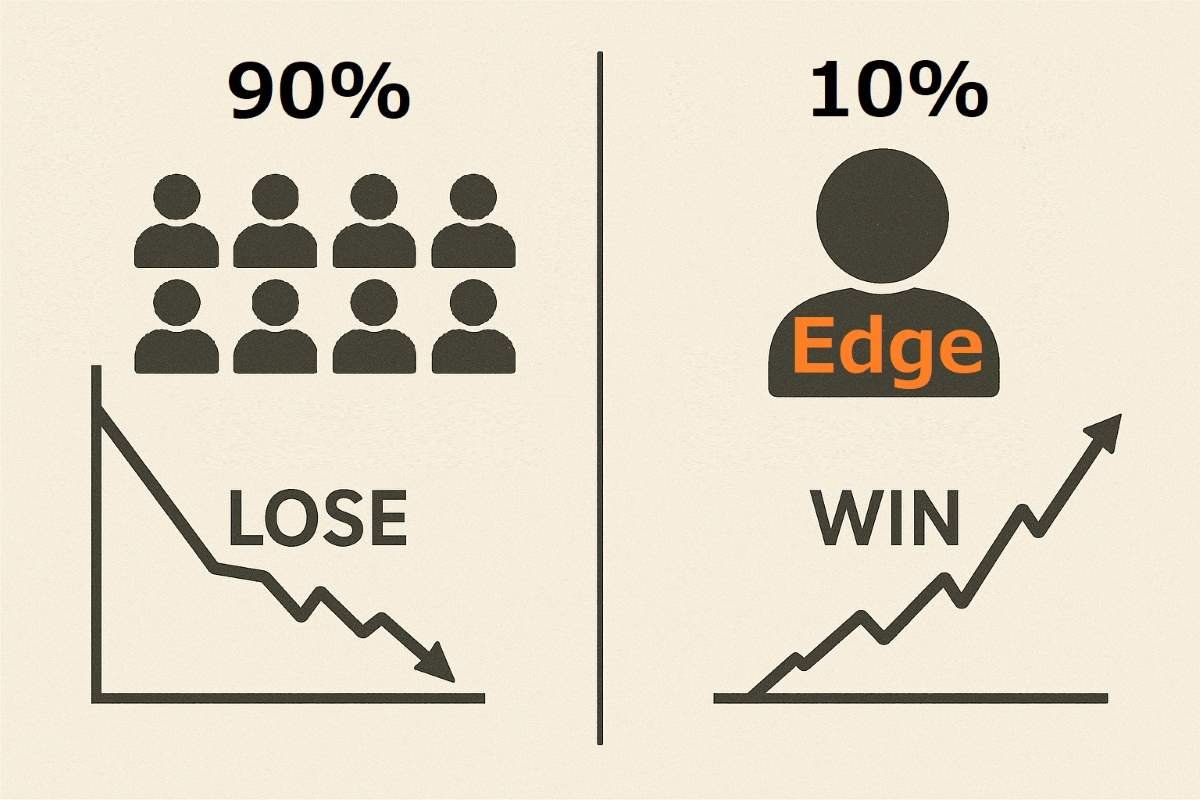
“Why do so many traders struggle to stay profitable?”
“What’s the real difference between professionals and amateurs?”
The answer almost always comes down to one thing: an edge.
An edge isn’t talent or “good intuition.”
It’s a mathematical and statistical advantage that stays positive over the long run.
In this article, we won’t treat an edge as a vague “strength.” We’ll break it down as a structure you can explain with numbers.
You’ll see why a strategy can be profitable even with a 40% win rate, what to check in a backtest, and the common traps that make people think they have an edge when they don’t.

What Is a Trading Edge? A Statistical Advantage That Pays Over Time
A trading edge is a “statistical tilt” that leaves you profitable when you repeat the same approach over many trades.
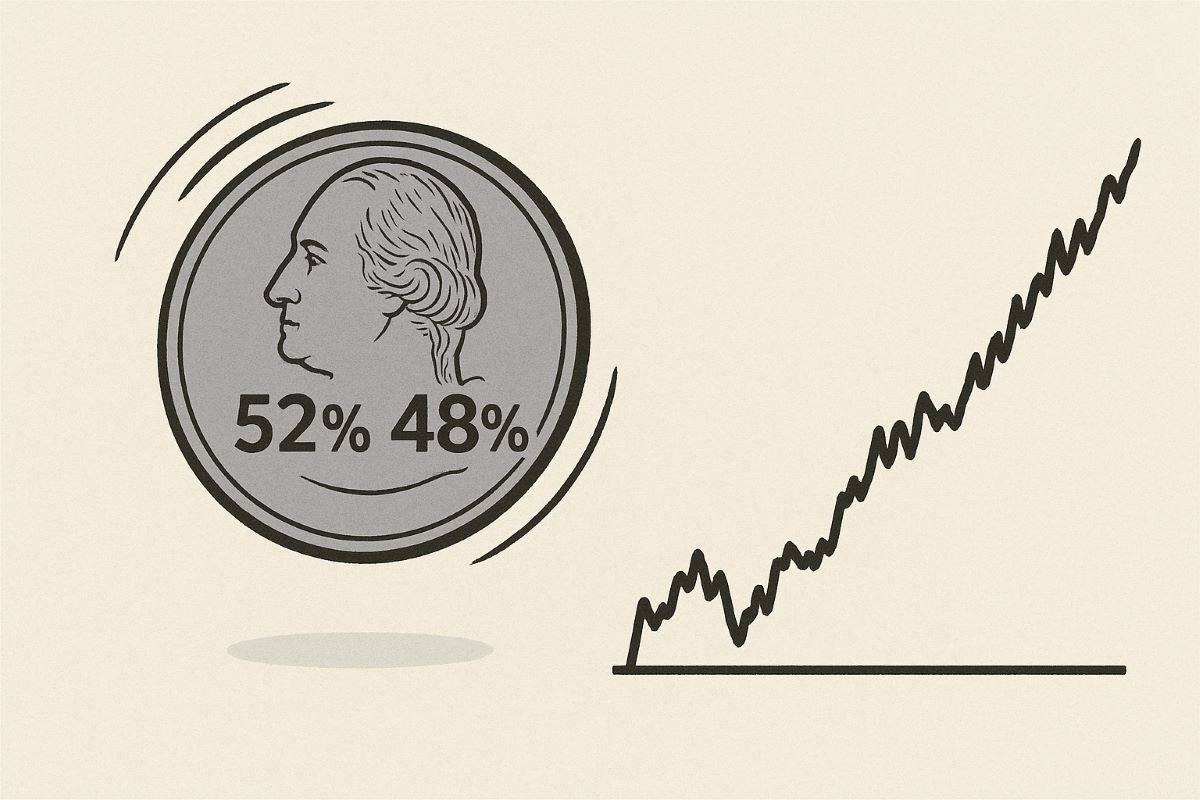
An easy way to picture it is a coin that lands heads vs. tails at 52:48.
You can lose once—or even a few times—but as the number of trials grows, that small bias starts to show up, and the overall result tends to move in a positive direction.
The key point is that an edge is not about winning one trade.
It’s about having a positive average outcome across many trades.
So an edge isn’t luck or gut feel. It’s repeatability you can justify with numbers.
Related: Probability-Based FX Trading: A Simple Guide to Expectancy, Win Rate, and Risk Management
Why an Edge Matters: The Common Trait of Traders Who Keep Profits
Trading without an edge often turns into wandering around break-even expectancy while paying costs (spreads and fees).
Over time, those costs stack up and tilt the odds against you—making it more likely your account slowly shrinks.
1) It removes “kinda/sorta” decisions and makes results repeatable
Markets are uncertain by nature. If you trade based on vibe or intuition, your decisions will drift.
Traders with an edge define rules like “enter here / exit here”, so they can take the same action under the same conditions.
2) It becomes a decision anchor when emotions kick in
After a losing streak, people hesitate to cut losses, or they take profits too early. The process breaks down.
An edge gives you something to lean on: confidence that “this rule set is positive over the long run”, which helps you avoid emotional trading.
3) It creates consistency—and consistency is what compounds
Traders who stay profitable focus less on single wins and losses, and more on “did I follow the rules consistently?”
Even during a drawdown, a statistically sound method should converge toward its expected outcome as the sample size grows.
Bottom line: An edge is the only real foundation for staying disciplined and profitable in an uncertain market.
Related: Emotions in Forex Trading: 7 Triggers That Break Your Rules (And How to Fix It)
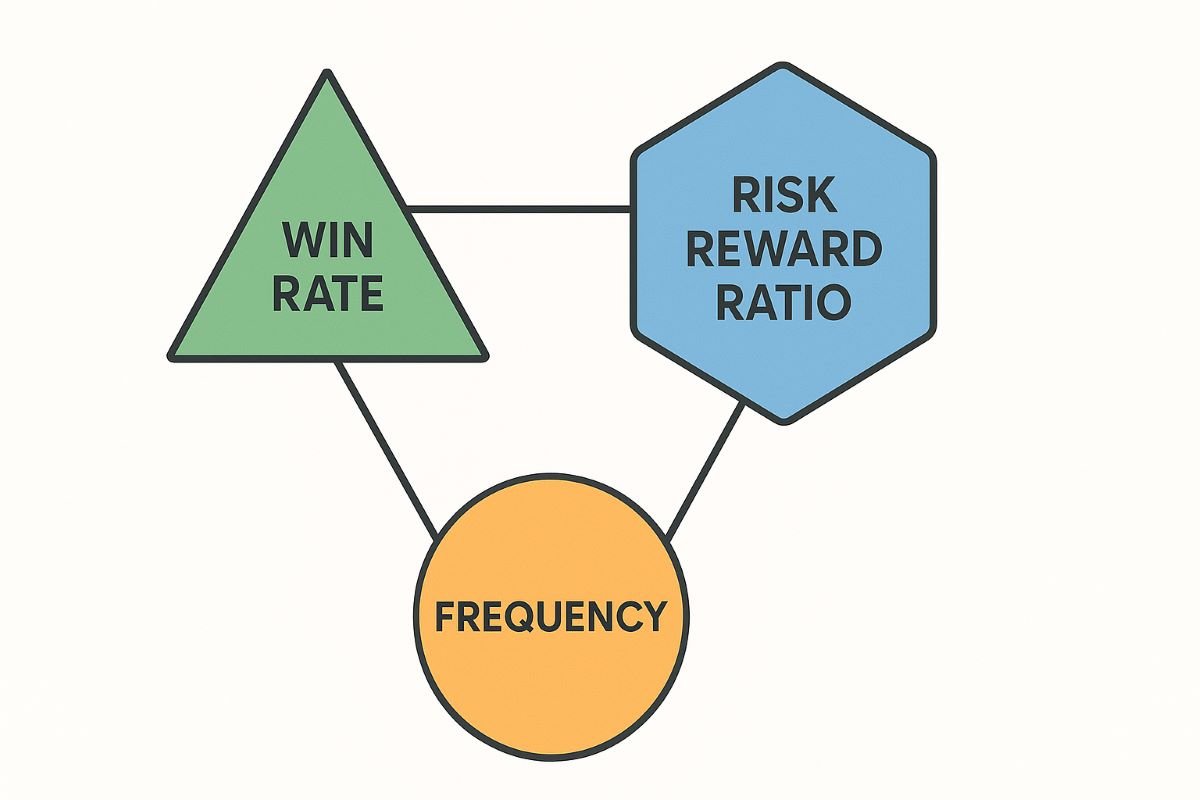
What Creates an Edge? The 3 Core Factors (Win Rate, RR, Frequency)
An edge isn’t “strength” or a secret trick. It’s a combination of measurable factors.
Once you understand these three, you can evaluate a strategy more objectively.
1) Win Rate
The percentage of trades that end in profit.
If you win 6 out of 10 trades, your win rate is 60%.
But a high win rate doesn’t guarantee profitability. If your losses are large, you can still lose overall.
Judging a strategy by win rate alone is risky.
Related:Stop Chasing Win Rate: How to Evaluate Forex EAs with Expectancy, Risk-Reward & Drawdown
2) Risk-Reward Ratio (RR)
The ratio between the loss you accept and the profit you aim for on each trade.
Example: risking $50 to target $100 is an RR of 1:2.
Even with a modest win rate, a strong RR can still produce profits over time.
3) Opportunity Frequency
How often the setup occurs over a given time period.
Even a great edge can feel unstable if it only shows up once a year. Frequency affects how quickly results “smooth out.”
Most Important: One Metric That Combines All 3 — Expectancy (Expected Value)
If you want to express an edge in one number, the core is expectancy.
| Expectancy | = | (Win Rate × Avg Win) – ((1 – Win Rate) × Avg Loss) |
Example: Win rate 40%, average win 8,000 JPY, average loss 4,000 JPY
Expectancy = (0.4 × 8,000) – (0.6 × 4,000) = 3,200 – 2,400 = +800 JPY
Even with a 40% win rate, a good RR can keep the average positive.
That’s why “low win rate = losing strategy” is not true.
Summary: An edge isn’t a single nice-looking stat like win rate or RR. It’s the condition where expectancy is positive.
Related: FX Trading Expectancy (EV) Explained: EAs, Win Rate, Risk-Reward & Money Management
Build Your Own Edge: 4 Steps (Hypothesis → Rules → Test → Live)
An edge isn’t something you “find lying around.” You discover it, test it, and refine it.
The process is simple and follows four stages.
Step 1: Form a hypothesis (look for a market “tilt”)
Start with a hypothesis: “In this situation, price is more likely to move this way.”
It can be a technical pattern, a post-news reaction, or anything you can describe.
What matters most is that you can explain why it might work.
Step 2: Turn it into rules (same conditions → same decisions)
Convert the hypothesis into rules with no ambiguity.
- Entry: what conditions trigger a trade
- Take profit: where you lock in gains
- Stop loss: where you cut losses
If you leave “vibes” or “kinda feels right” in the rules, you can’t test or improve the strategy properly.
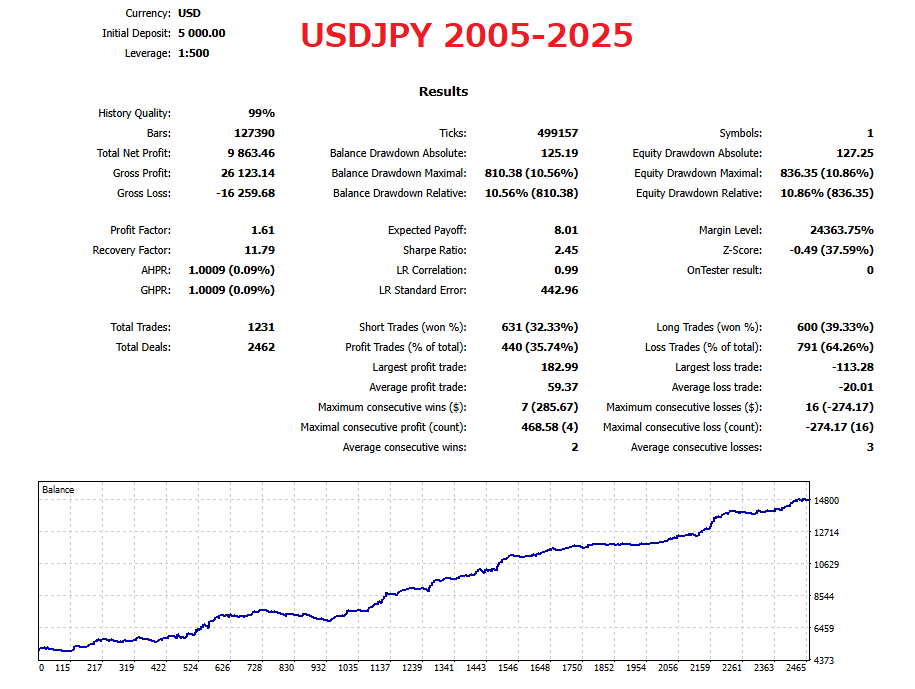
Step 3: Backtest (calculate expectancy)
Test the rules on historical data and check the following:
- Win rate
- Average RR (average win / average loss)
- Opportunity frequency
- Whether expectancy is positive
This is where feelings don’t matter. Numbers are the verdict.
Step 4: Forward test (absorb real-market “friction”)
Even if a backtest looks good, it’s risky to deploy big size right away.
Use a demo or very small position size to confirm real-world factors like slippage and execution conditions, and then refine your rules.
Use EAs to speed up testing
If you want faster and more objective testing, using an EA (automated trading) can help.
- Faster testing: run long periods of data in a short time
- No drift: the EA makes the same decision every time under the same conditions
- Easier to refine: weaknesses show up in the numbers
Related: What Is a Forex EA (MT4/MT5)? An Automated Trading Guide
Important: Indicators and Signal Tools Don’t “Come With” an Edge
“Buy this indicator and you’ll win.”
“This signal tool gives perfect entries.”
These claims sound tempting, but they’re a common misunderstanding.
Tools don’t contain an edge by default.
Tools are amplifiers, not the source
Indicators and signals are tools that process past price data and make it easier to see patterns or receive alerts.
Even great tools won’t help if you don’t have a tested blueprint—your rule set.
Tools can make it easier to execute your edge.
But the edge itself comes from your hypothesis, rules, and testing.
Watch out for exaggerated marketing
Ads like “90% win rate” or “X% profit every month” are everywhere.
Common tactics include:
- Cherry-picking: showing results from only favorable market periods
- Overfitting: tuning parameters too closely to past data, then failing in live markets
- Pressure selling: “limited offer” tactics that reduce clear thinking
How to use tools the right way (3 steps)
- Use the tool to spark a hypothesis: “This signal might work under certain conditions.”
- Define your rules: decide entries, exits, take profit, and stop loss.
- Test it yourself: backtest and confirm expectancy is positive.
Related:
Why FX Signal Tools Often Fail in Live Trading (Repainting & No Verifiable Tests)
Why FX Indicators Alone Don’t Work | Turn Them Into an Edge with an EA
The Biggest Enemies of an Edge: Two Traps That Make You Think You Have One
The most dangerous situation is believing you have an edge when you don’t.
That illusion hides the real cause of losses and makes you repeat the same mistakes.
Trap 1: Random wins feel like skill (“reward from randomness”)
Even a weak, poorly justified entry can win sometimes.
The problem is that the brain tends to store these “reasonless wins” as successful patterns.
That reinforces inconsistent behavior, and you end up building a “strategy” that can’t be tested or reproduced.
Trap 2: Small samples (a 10-trade win rate means little)
Going 7 wins out of 10 doesn’t prove a strategy is good.
With small sample sizes, randomness can distort results heavily.
| Number of trades | Reliability | Rule of thumb |
|---|---|---|
| Up to ~20 | Low | Randomness dominates |
| Around 50 | Medium | You may see a tendency, but it’s early to judge |
| 100+ | Improving | Finally becomes usable data for comparison and refinement |
Three questions that break the illusion
- Did that profit come from clear rules?
- Do you have enough trades (a large enough sample)?
- Are you judging “rule-following losses” and “rule-breaking wins” the same way?
Bottom line: An edge doesn’t live inside flashy wins. It comes only after boring, steady testing.
Risk Management: The Minimum Rules That Protect Your Edge
Risk management can get complicated, but these basics help prevent your edge from being destroyed by a single “accident.”
- Set a max loss per trade: keep it at a level that won’t seriously damage your account
- Watch total exposure: don’t let combined risk across open positions become too large
- Design rules you can follow: if you feel forced to “win it back” by increasing size, your risk is too heavy
Even with an edge, if your account runs out of capital first, you’ll never reach the point where the edge can play out.
Risk management isn’t mainly about “winning more.” It’s about surviving long enough for the edge to show up.
Related:EA Lot Size & Position Sizing: Fixed vs Auto Lot, Risk % Rules, and Starting Deposit Math
Conclusion: An Edge Is a Solid Rule Set (Tested, Positive Expectancy)
An edge isn’t secret information or a special talent.
It’s a rule set with positive expectancy—tested and executed the same way, again and again.
- Clear entries and exits
- Positive average outcome (expectancy > 0) you can explain
- Sufficient samples to confirm repeatability
- A design you can execute consistently without emotions taking over
Once you reach that point, trading stops being a coin flip. It becomes decision-making based on probability and statistics.
 MQL5
MQL5
 Myfxbook
 YouTube
 X
X
 GOGOJUN