

Swap is smaller than spreads and commissions, right?
Honestly, I feel like I don’t need to worry about it much.

I get it. But swap is a fixed cost that stacks up every time you hold a trade overnight.
It’s hard to notice at the moment you enter, but if you hold positions often, it can become a bigger drag than spreads + commissions.
But if long and short are just the opposite sign,
won’t it cancel out if my trades are roughly 50/50?
That’s the trap. In real markets, swap is often asymmetric (the negative side is larger), and some symbols are negative on both sides.
So even if you’re 50/50, you can still end up paying swap on average.
I heard EA users need to be extra careful. Why?
EAs often keep positions open around the clock, which makes overnight holds much more frequent.
Even if your strategy isn’t “bad,” swap can stack up over days and become the reason your equity doesn’t grow the way you expect.
So what should I do in practice?
Three steps:
1) Measure: Check your total swap in your MT5 Account History to see the real drag.
2) Design: Use holding-time rules (crossing rollover or not) and symbol selection to reduce swap exposure.
3) Operate: Compare brokers by total trading cost including swap (and consider swap-free accounts if they fit your conditions).
That’s how you avoid losing to “hidden costs.”

Introduction: Swap Is a “Silent” Trading Cost
When you’re new to FX or gold (XAUUSD), you usually focus on spreads and commissions—while swap (swap points) gets pushed aside.
But swap can become a cost that quietly eats into your account every time you hold a position overnight. It’s small day by day, but it’s easy to miss—and that’s exactly why it becomes a “hidden cost.”
In many cases, swap is not balanced between long and short. The negative side is often larger, and some symbols are negative on both sides. That means a strategy can be roughly 50/50 long vs. short and still end up paying swap on average.
This matters most if you hold trades for days or weeks, or if you run an EA 24/7. In some cases, the swap drag can even be larger than spreads and trading commissions.
So swap is not a “bonus.” It’s part of total trading cost (spread + commission + swap), and you should build it into broker selection and trade design.
- What you’ll learn: Swap basics, when it’s charged (rollover / “triple swap”), how to check it in MT5, and how to make hidden costs visible and controllable
- Who this is for: Beginner to intermediate traders, EA users, and anyone who hasn’t paid much attention to swap so far
- Bottom line: Treat swap as a cost you should measure and then reflect in testing (backtest/forward) and operations (broker choice/holding rules)
Related:MT5 EA Trading Costs Explained: Spread, Commission, Slippage & Swap (Backtest vs Live Reality)
Note: The numbers and dollar examples in this article are simplified for clarity. Swap rates, rollover timing, and multipliers vary by broker, account type, symbol, and holidays. Always confirm using MT5 Specifications and your Account History (Swap column).
What Is Swap? (Swap Points Basics)
Swap (swap points) is the interest-rate differential / funding cost that is credited or charged when you hold a position overnight. Unlike spreads and commissions, it’s easy to overlook at entry—but as holding days add up, swap can accumulate steadily and become a hidden cost.
Why Does Swap Exist? (Interest Differential / Funding Costs)
In spot-style FX, you can think of a trade as:
- The currency you buy is like the one you “hold” (interest component)
- The currency you sell is like the one you “borrow” (interest cost component)
So, in a simplified view, swap reflects:
(Interest on the bought currency) − (Interest on the sold currency)
However, real swap rates rarely match the clean “theoretical” interest differential. Brokers apply adjustments (funding/hedging costs and markup), which is why you often see:
- Asymmetry (the negative side is much larger)
- Negative on both sides (both long and short pay swap)
A common beginner mistake is thinking, “If the interest differential should be positive, I’ll receive swap.” In practice, broker conditions can still make it negative.
For CFDs like gold (XAUUSD), indices, or crypto CFDs, swap is better understood as an overnight funding fee. On some symbols, it can be much larger than typical FX pairs, so the impact can be more severe.
When Is Swap Charged? (Rollover Time / “Triple Swap”)
Swap is usually posted around New York 17:00, at the daily date change known as rollover. What matters is not “when you placed the order,” but whether your position stayed open across rollover.
Many major MT4/MT5 brokers set their server time to GMT+2 (winter) / GMT+3 (summer) so that daily candles align neatly into 5 weekdays. In that setup, rollover is typically close to:
- Server time 00:00 (midnight) around the daily boundary
Tip: You can often find rollover timing and server time in your broker’s trading conditions. The most reliable method is to check your Account History and see exactly when swap was posted on your account.
In FX, brokers commonly apply a “weekend adjustment,” posting multiple days of swap on one rollover. This is why you often see “triple swap” on a specific weekday (commonly Wednesday), though rules can vary by broker and symbol.
- Crossing rollover on the “multiplier day” can make swap jump sharply
- If you frequently hold overnight, this can materially affect performance—even if everything else looks low-cost
Note: The “triple swap day” and holiday adjustments can differ by broker and by symbol (especially CFDs). Always confirm your broker’s rules and verify using your own account history.
Why Swap Becomes a “Hidden Cost” (Real Example)
Unlike spreads and commissions, swap is not deducted at the moment you place a trade. It shows up after you hold overnight, and it can chip away at your P&L without you noticing—especially if you don’t review your history.
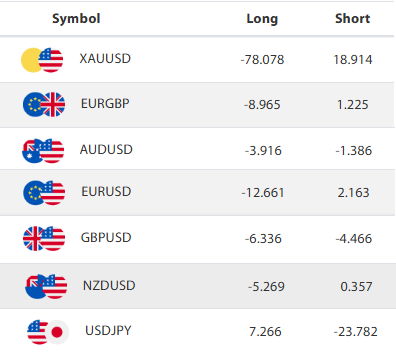
This table shows how swap differs between Long and Short by symbol. The key is that swap often becomes “hard to see but easy to feel” because of two structural reasons.
Reason 1: Long and Short Are Often Not Symmetric
Many beginners assume: “Long is negative, short is positive (or vice versa), so it should cancel out over time.”
But in reality, swap is often asymmetric, where one side’s negative swap is much larger. That means if your strategy has any directional bias, swap can become a daily headwind.
- XAUUSD (Gold): Long -78.078 / Short +18.914 → The long-side drag is huge, and holding for a few days can materially reduce P&L
- EURUSD: Long -12.661 / Short +2.163 → “Short is slightly positive,” but the long-side cost is much larger
- USDJPY: Long +7.266 / Short -23.782 → One direction can be a tailwind while the other is a strong headwind
Practical takeaway: If your strategy tends to be long-heavy or short-heavy, swap can quietly reduce your edge every day.
Reason 2: Some Symbols Are Negative on Both Sides
Even worse, some symbols charge swap on both long and short. In that case, you pay a “holding fee” no matter which direction you’re in.
- AUDUSD: Long -3.916 / Short -1.386 (both negative)
- GBPUSD: Long -6.336 / Short -4.466 (both negative)
With this structure, swap behaves like a fixed cost that grows with time. For swing trades and always-on EAs, it can matter a lot.
Why You Can Lose Even at 50/50 Direction (Expected Swap)
If you’re thinking, “But I’m roughly 50/50 long and short,” you can estimate the average drag with a simple concept:
Expected Swap (rough) = (Long + Short) / 2
| Symbol | Long | Short | Expected Swap ((Long+Short)/2) | Quick note |
|---|---|---|---|---|
| XAUUSD | -78.078 | +18.914 | -29.582 / day | Negative on average even at 50/50 (big drag) |
| EURUSD | -12.661 | +2.163 | -5.249 / day | Negative on average (asymmetric) |
| USDJPY | +7.266 | -23.782 | -8.258 / day | Negative on average (one side dominates) |
| AUDUSD | -3.916 | -1.386 | -2.651 / day | Both sides negative (no offset) |
| GBPUSD | -6.336 | -4.466 | -5.401 / day | Both sides negative (meaningful drag) |
So “balanced direction” does not automatically mean “safe.” Depending on the symbol, you can still pay swap steadily as days pass. That’s the core reason swap becomes a hidden cost.
Why It Hits Hard: It Grows by Days, and Can Spike on Certain Rollovers
Spreads and commissions scale with number of trades. Swap scales with number of holding days. Even if you trade less, holding overnight more often can increase your total cost.
- Small daily cost becomes large over time: e.g., an average -5/day over 10 days is about -50
- Some rollovers post multiple days at once: “triple swap” and holiday adjustments can create larger single-day charges
Because multipliers and holiday rules vary, the safest approach is always to confirm with your own Account History (total swap).
Feel the Impact: Swap vs. Spread + Commission (Per 1 Lot)
Using a major pair like EURUSD as a simple example, many low-cost accounts look like this:
- Spread: around 0.2 pips (example)
- Commission: around $7 round-turn (example)
On EURUSD, a common rule of thumb is 1.0 pip ≈ $10 per 1 lot (when your account currency is USD). That makes a 0.2 pip spread roughly $2.
So if you enter and exit quickly, your visible cost is roughly:
$2 (spread) + $7 (commission) = $9 per round-turn (example)
But once you hold overnight, the story changes. Swap does not scale with the number of trades—it scales with the number of holding days.
How to Think About “Points” (Quick Mental Math)
Some brokers display swap in points. You don’t need perfect math to compare brokers or to feel the impact—just keep a practical rule of thumb.
- EURUSD is commonly quoted with 5 digits → 1 point = 0.1 pip
- EURUSD 1 lot → 1.0 pip ≈ $10 (USD accounts)
- So as a quick feel → 1 point ≈ $1 per day per 1 lot (rough guide)
Important: This is a simplified rule for intuition. Actual conversion depends on symbol specs, tick value, and account currency. Always confirm with Specifications and your Account History (Swap).
Why Swap Becomes a “Hidden Cost” (Compared Side-by-Side)
Example: EURUSD (1 lot) Held Overnight
From the table example, EURUSD shows Long -12.661 / Short +2.163. If those values are in points, and we apply the rough mental conversion (1 point ≈ $1 per 1 lot):
- Long swap: -12.661 points ≈ -$12.661 per day
- Short swap: +2.163 points ≈ +$2.163 per day
Now compare that to the “visible cost”:
- Visible cost (round-turn): $2 (spread) + $7 (commission) = $9 (example)
- Hidden cost (1 day): long swap ≈ $12.7
Takeaway: In this example, holding a EURUSD long position overnight can cost more than the spread + commission. This is a common reason people feel, “My strategy should be working, but my equity isn’t growing.”
Example: USDJPY Changes by Direction
USDJPY in the example table shows Long +7.266 / Short -23.782. Simply changing direction can flip your daily carry from a tailwind to a headwind:
- Long: could be positive (credit)
- Short: could be strongly negative (debit)
This is the risk: even on the same symbol, your strategy’s directional bias can change your expected performance through swap.
Example: Both Sides Negative (AUDUSD / GBPUSD)
- AUDUSD: Long -3.916 / Short -1.386 (both negative)
- GBPUSD: Long -6.336 / Short -4.466 (both negative)
When both sides are negative, there is no “offset.” Swap behaves like a holding fee, and it can materially drag swing trading and always-on EAs.
Key Points to Remember (Simple and Practical)
- Spread + commission scale with the number of trades (e.g., ~$9 round-turn per 1 lot in this example).
- Swap scales with holding days (e.g., $10+ per day can happen depending on symbol and direction).
- If swap is shown in points, you can use quick mental math for intuition—then verify using Account History.
Reminder: Numbers above are simplified for clarity. Always confirm using your broker’s live specs and your own account history.
Swap-Free Accounts: A Practical Way to Reduce Overnight Costs
Because swap accumulates with each overnight hold, it can become a meaningful cost for swing trading and 24/7 EA operation. One option is a swap-free account.
A swap-free account can reduce swap close to zero under certain conditions, which helps remove this “hidden cost.” However, it’s not always available to everyone, and some brokers replace swap with other fees. You should treat it as a total-cost decision, not a “free lunch.”
How Swap-Free Accounts Work (Benefits and Use Cases)
- Goal: Reduce or remove overnight swap / financing costs
- Benefit: Helps protect your edge if you hold positions for multiple days
- Best for: Swing traders, long-hold EAs, and symbols with large swap (often CFDs like XAUUSD)
Islamic Accounts: The Standard Model
Many swap-free accounts are offered as Islamic accounts (to comply with rules that prohibit interest). Depending on the broker, this can mean:
- Eligibility restrictions (region/account type)
- Verification requirements
- Non-eligibility for some users
Some Brokers Offer Swap-Free Options Beyond Islamic Accounts (Conditions Apply)
Some brokers offer swap-free options that may be available more broadly. If your trading style involves frequent overnight holds, a swap-free setup can reduce the swap drag.
Examples:
HF Markets (HFM),
Exness
Important: “Zero Swap” Can Come With Other Costs
To prevent abuse (arbitrage, swap harvesting, etc.), brokers may apply conditions such as:
- Symbol restrictions: only certain FX pairs/CFDs qualify
- Time limits: free swap up to N days, then an admin fee may apply
- Regional/account-type limits: availability varies by jurisdiction and account
- Policy enforcement: retroactive charges or account restrictions if rules are violated
Also, even if swap is removed, brokers may increase total cost via:
- wider spreads
- higher commissions
- separate overnight/admin fees
Bottom Line: Decide by Total Trading Cost
Before switching, check:
- Eligibility: your region and account type
- Symbols: what you actually trade (FX pairs, XAUUSD, indices, etc.)
- Holding rules: day limits and admin-fee triggers
- Total cost: spread + commission + any admin fees
- Verify: test with a demo/small size and confirm in Account History
Key idea: swap-free only matters if your total cost is genuinely lower for your trading style.
How to Check Swap in MT5 (Beginner-Friendly)
MT5 (Desktop): Market Watch → Specification
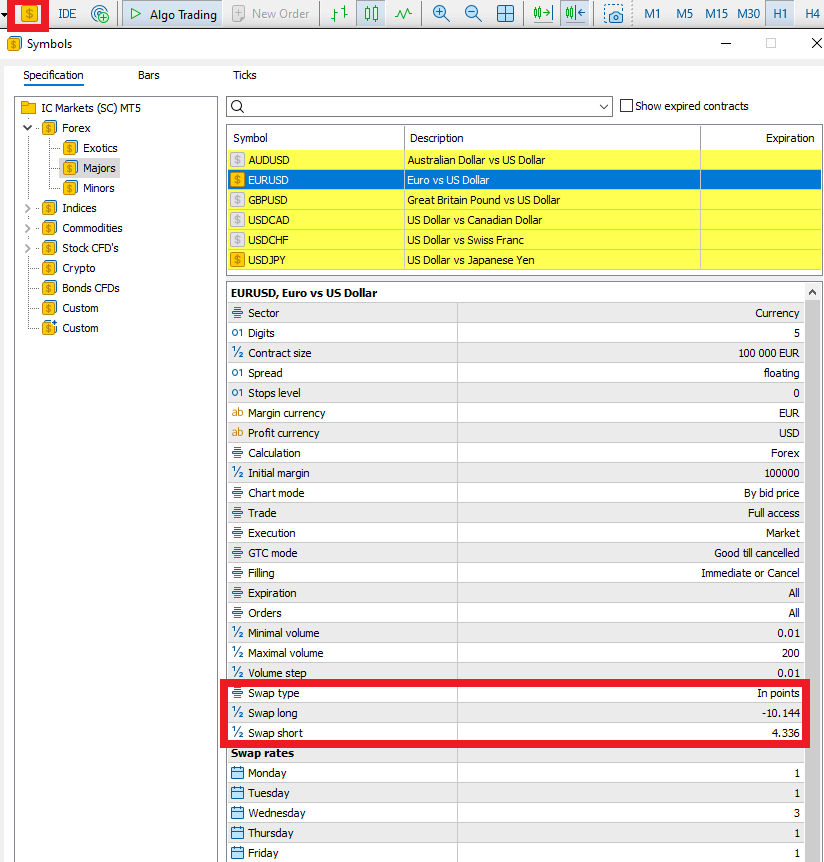
- Open Market Watch (shortcut: Ctrl+M).
- Right-click the symbol you want (e.g., EURUSD) → select Specification.
- Check the following fields:
- Swap type: whether swap is shown in points, money, or percent
- Swap long: swap for long (buy) positions, per 1 lot per day
- Swap short: swap for short (sell) positions, per 1 lot per day
- 3-day swap (weekday): the day when multiple days may be posted at once (varies by broker/symbol)
If Swap Type Is “In points”: Use Quick Intuition First
If your broker shows swap in points, you can use a simple mental model (then confirm later in your history):
- For many 5-digit FX pairs: 1 point = 0.1 pip
- For EURUSD 1 lot in a USD account: 1 pip ≈ $10
- So a rough feel is: 1 point ≈ $1 per day per 1 lot
Final confirmation should always be done using Account History, because actual posting depends on broker rules and adjustments.
If Swap Type Is “In money” or “In percent”
- In money: already shown as a currency amount. Multiply by days (and consider any multiplier days).
- In percent: calculation rules can differ (day-count basis, formula). If unsure, confirm the actual posted amounts in Account History.
Also Check on Your Broker’s Site
- Rollover time and server time policy
- Multiplier days and holiday adjustments
- Units and calculation basis (points/money/percent) and account-type differences
How to Confirm the Real Swap Charged in MT5 Account History
The Specifications screen shows the broker’s baseline settings. Account History shows what actually happened on your account—the real posted amounts.
If you suspect swap is hurting performance, don’t guess. Make it visible with your history.
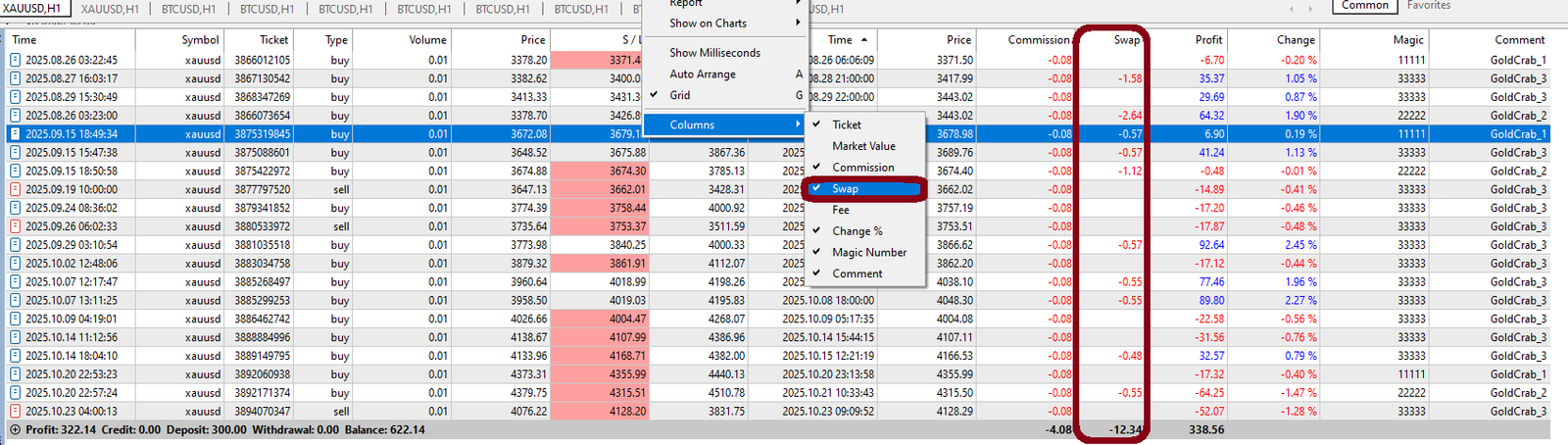
Step 1: Open Account History
Open the terminal panel (often labeled Toolbox or Terminal depending on build) and click Account History.
- Shortcut: Ctrl + T
Step 2: Set a Clear Time Range
Right-click inside Account History and choose a time range. Using “All History” can be noisy—start with a focused period (e.g., last month) so the totals are easy to interpret.
- All History
- Last 3 Months / Last Month
- Custom Period
Step 3: Enable Swap (and Commission) Columns
- Right-click inside the history table.
- Open Columns.
- Enable Swap (and Commission if you want to compare).
Now you will see the swap posted per trade, as well as totals for the selected period.
Step 4: Read the Totals (This Is the Key)
Look at the total swap for the period, and compare it to total commission:
- If total swap is significantly negative, overnight holds are acting like a fixed cost.
- If total swap is larger than total commission, swap is a major cost driver.
In the screenshot example, total swap is -12.34 and total commission is -4.08.
-12.34 ÷ -4.08 ≈ 3.0 → swap is roughly 3× the commission.
This is how you catch the situation where spreads/commissions look low, but swap is quietly draining performance. Once you see it, you can adjust your holding rules, symbol selection, or account/broker setup.
How to Build Swap Into Your Trading (From Testing to Execution)
Knowing swap exists is not enough. The goal is to treat swap as part of total trading cost (spread + commission + swap) and reflect it in both testing (backtest/forward) and execution (broker choice/holding rules).
Action 1: Start With Real Data (Use Total Swap in Account History)
Swap changes with broker rules, holidays, and market conditions. If you only use theoretical calculations, you can be off.
- Check total swap over a defined period (start with last month)
- Check total commission at the same time
- If possible, isolate the symbols you trade most and identify which ones create the biggest drag
Goal: quantify how much swap is impacting your equity so you know what to fix first.
Action 2: Align Backtests/Forward Tests With “Swap-Included” Reality
A common reason a backtest looks good but live results don’t is optimistic cost assumptions. Strategies with small edge are especially vulnerable—swap can erase the profit.
Make “swap-included” results your baseline. MT5 Strategy Tester typically reflects broker symbol settings, but it’s still wise to stress-test by using stricter assumptions where possible and validating against forward results.
Action 3: Treat Holding Time as a Strategy Variable
Swap scales with the number of holding days. Holding time is not just a preference—it’s a cost variable.
- Avoid overnight holds on symbols where swap is extreme (close before rollover when appropriate)
- Conditioned holds: only hold overnight when expected edge clearly exceeds swap drag
- Multiplier/holiday awareness: reduce exposure around rollover rules that can post multiple days
Warning: Don’t over-modify a working strategy just to dodge swap. The better target is a strategy that remains positive even after swap.
Action 4: Adjust Symbol Selection (Choose Swap-Resistant Markets)
Swap differs massively by symbol. CFDs (e.g., XAUUSD) often carry heavier overnight costs.
- The same strategy can perform very differently on a different symbol due to swap
- For longer holds, prefer symbols with smaller long/short gaps (less asymmetry)
- Be cautious with symbols that are negative on both sides if you hold overnight frequently
Action 5: Compare Brokers by Total Cost (Not Just Spread)
A low-spread, low-commission account can still be expensive if swap is unfavorable.
- Short-term trading: spread + commission dominate
- Multi-day holds: swap dominates (broker differences become much more important)
Choose the combination that minimizes total cost for your trading style.
Action 6: Consider Swap-Free Accounts (Only If Total Cost Truly Drops)
If you hold overnight frequently and swap is clearly reducing your edge, a swap-free setup can be worth testing. But “zero swap” may come with admin fees or wider spreads. Test with a demo or small size and confirm using Account History.
Summary: The real solution is to stop treating swap as a surprise. Build it into design (holding rules), testing (realistic assumptions), and execution (total-cost optimization). This alone can fix many cases where “my strategy should work, but my equity doesn’t grow.”
Conclusion: Make Swap Visible and Manage It as Total Trading Cost
Swap is a “hidden cost” because it doesn’t feel immediate. It hits after you hold overnight and can gradually reduce performance—especially for swing traders and always-on EAs.
In real broker conditions, swap is often asymmetric or even negative on both sides. That’s why even a roughly 50/50 long/short strategy can still pay swap on average.
The safe approach is to treat swap as part of total trading cost (spread + commission + swap) and build it into your trading process from the start.
Key Takeaways
- Swap scales with holding days: “overnight holds” drive the cost
- Asymmetry and both-negative swap are common: 50/50 direction does not guarantee neutrality
- Multiplier/holiday adjustments can spike costs: swap may post multiple days at once
- Account History is the strongest evidence: Specifications are settings, History is reality
- Fix it with total-cost optimization: holding rules, symbol selection, broker choice, and swap-free (when it truly helps)
Start by checking Specification to understand the baseline, then confirm your real costs in Account History. If swap is larger than expected, adjust your holding rules and broker setup so your edge survives after all costs.
 MQL5
MQL5
 Myfxbook
 YouTube
 X
X
 GOGOJUN