

Introduction: Lot Size Shapes Both Your EA Results and Your Survival Rate
An EA (Expert Advisor) isn’t judged by its entry and exit logic alone. In real trading, the same EA can produce completely different outcomes depending on one thing: how you size your positions (Lot Size). Your profit curve, your drawdown (DD), and even whether the account survives can change dramatically.
Related: What Is a Forex EA (MT4/MT5)? An Automated Trading Guide
EA trading often runs for long periods while your account balance rises and falls. That’s why how you handle position size as your balance changes becomes a core part of risk control. Do you run a steady Fixed Lot, or let a Dynamic (Auto) Lot grow as the account grows? If you start without clear rules, you tend to overrate the EA during good times, then face larger-than-expected losses when conditions turn.
This article breaks down the key differences between fixed and auto lot sizing, then explains three common sizing approaches (balance-based sizing, price-aware sizing, and risk % × Stop Loss) in a way that’s easy to apply. We also cover a practical method to reverse-calculate your starting deposit and starting lot from Max Drawdown, a minimum safeguard for instruments with shifting price levels (such as Gold), and why Grid/Martingale-style EAs require a completely different way of thinking about lot sizing.
*This article explains general risk management concepts and is not investment advice. Fast markets, gaps, and slippage can lead to losses beyond what you expect.
Fixed Lot vs Dynamic Lot: What Actually Changes
There are two broad ways to decide your lot size:
- Fixed Lot: you trade the same lot size regardless of your balance (Balance) or Stop Loss (SL) distance.
- Dynamic Lot (Auto Lot): your lot size increases or decreases based on conditions such as balance, SL distance, or a target risk percentage.
The longer you run an EA, the more your balance will fluctuate. That’s why your sizing method affects both how fast performance grows and how much stress your account can handle.
Fixed Lot: More stable, but slower growth
Fixed lot sizing is simple and consistent. Because your position size doesn’t change as the account grows, compounding is limited. Over time, the balance often grows more slowly compared with sizing methods that scale up.
Dynamic Lot: Faster growth, but risk rises at the same time
If you increase your lot size as your balance grows, profits can compound. That’s the appeal.
But here’s the key point: when lot size goes up, risk goes up too. With the same EA, drawdown depth and the chance of blowing the account can change sharply. Dynamic sizing can accelerate growth, but it can also accelerate failure. You must pair it with clear risk rules (max DD tolerance, risk %, and a strict scale-down rule).
Backtest Comparison: Fixed Lot vs Auto Lot
Many EAs include both a manual fixed-lot setting and an Auto Lot (dynamic sizing) option.
The important point is this: the EA logic (entries/exits) doesn’t change. Only the position sizing changes. So the difference in results is not “better strategy vs worse strategy.” It’s mostly the difference between compounding and risk amplification.
Test setup: same EA, same conditions, only lot sizing changes
- Same EA, same backtest conditions
- Symbol: EURUSD
- Initial Deposit: 300 USD in both tests
- Only difference: Fixed Lot (0.01) vs Auto Lot
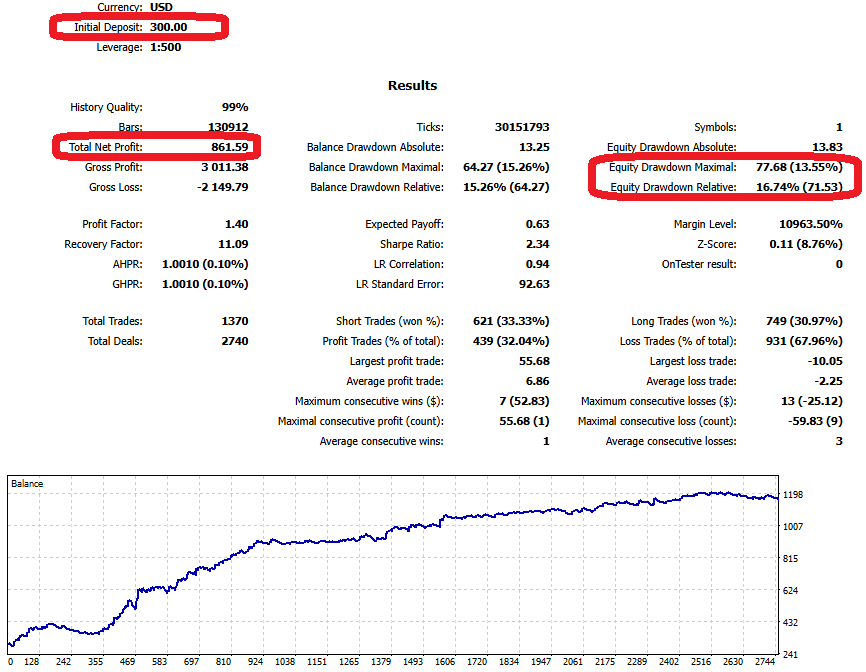
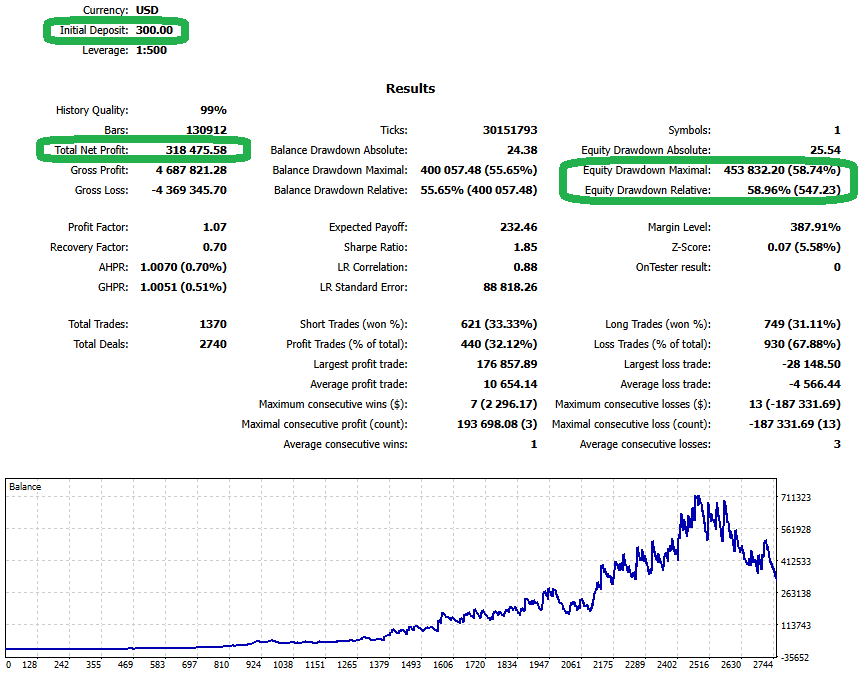
Summary: Auto Lot increases both returns and pain
With fixed lot (0.01), position size stays constant, so the P&L swings are easier to control. Even as balance increases, lot size does not, so growth is usually slower.
With Auto Lot, lot size tends to increase as balance grows, which behaves like compounding. That can produce much larger returns, but in bad periods, losses expand by the same mechanism. That’s why drawdown (DD) can become far deeper.
Related: EA Drawdown (DD) Explained: How to Read MT5 Reports, Focus on Equity DD, and Set a Risk Limit
| Metric (MT5 report) | Fixed Lot (0.01) | Auto Lot |
|---|---|---|
| Initial Deposit | 300.00 USD | 300.00 USD |
| Total Net Profit | 861.59 USD | 318,475.58 USD |
| Profit Factor (PF) | 1.40 | 1.07 |
| Equity Drawdown Maximal | 13.55% (77.68 USD) | 58.74% (453,832.20 USD) |
| Equity Drawdown Relative | 16.74% (71.53) | 58.96% (547.23) |
How to read it: prioritize DD% and the curve shape over profit
- Don’t compare Total Net Profit alone: Auto Lot grows position size, so profits look huge when things go well.
- Watch Equity DD % first: long-term survivability depends more on how deep you sink than how fast you rise.
- Notice PF did not improve: if profit explodes but PF doesn’t, you likely didn’t gain edge—you scaled risk.
- Be cautious after a big peak: Auto Lot can expand most during good regimes, then take heavy damage when conditions change.
Bottom line: Auto Lot can accelerate growth, but it also magnifies drawdowns. Judge it by DD% and account durability, not by the money figure alone.
Three Practical Ways to Set Lot Size (Position Sizing for EAs)
Choosing a lot size is the same as choosing your risk.
Below are three common approaches you’ll see in EA settings. The most stable long-term base is usually #3: Risk % × Stop Loss.
1) Balance-based sizing (example: 0.01 lot per 100 USD)
Example: 0.01 lot for every 100 USD of balance (500 USD balance → 0.05 lot)
This is the simplest approach and often appears in EA parameters as “balance-based lot.” It’s easy to manage because the rule is clear.
- Pros: simple, no calculation, easy to set
- Cons: when an instrument’s price level shifts, “the same lot” can mean very different risk
This method struggles on instruments with big long-term price changes, such as Gold (XAUUSD). If price rises several times over the years, the same 0.01 lot can produce much larger P&L swings for the same percentage move, which breaks risk consistency.
Example: if the price level is about 10× higher, a 1% move can create roughly 10× the dollar P&L swing. A drawdown that used to be 10 USD can become 100 USD under the same “rule.”
2) Balance + price-aware sizing (roughly “adjust to price level”)
This approach looks at both balance and the price level when adjusting lot size. Compared with pure balance-based sizing, it adapts better when prices drift over time.
- Pros: reflects the price level and reduces some of the drift
- Cons: it still doesn’t directly control “how much you can lose”
The core weakness is that it doesn’t fully incorporate Stop Loss (SL) distance or volatility. As a result:
- in wide-SL or high-volatility periods, losses can exceed what you expected
- you still need a separate rule for maximum loss %
So #2 is “more adaptive,” but it’s not a clean way to cap losses.
3) Risk % × Stop Loss (recommended: the most stable base)
Idea: you set a maximum loss per trade as r% of your balance, then calculate lot size backward from your Stop Loss (SL).
Example: If you risk 1% per trade and your SL is 20 pips, you compute a lot size that keeps the worst-case loss around 1%.
- Pros: the loss cap stays more consistent even when market conditions change
- Pros: works better across instruments with shifting price levels
- Cons: SL is required; gaps/news can cause slippage beyond the planned loss
In EA trading, the key question isn’t just “how much it makes,” but “can it survive the ugly periods.” This method builds the risk ceiling first, which is why it’s widely used as a long-term foundation.
Tip: Even when an EA says it uses Auto Lot, safety depends on whether the logic is actually based on risk % × SL (or something close to it).
How to Decide Your Deposit and Starting Lot (Reverse-Calculating From Max DD)
A common mistake is to deposit first, then struggle with lot size later. In practice, reversing the order makes risk control much easier. Start by estimating your Max Drawdown (Max DD), then reverse-calculate your starting deposit and starting lot.
This section shows a simple, repeatable way to answer: “How much capital do I need to run this EA?”
Step 1: Run a long backtest at the minimum fixed lot and record Max DD (USD)
Backtest as long as possible using the smallest fixed lot (for example, 0.01) and record Max Drawdown in USD.
Example: 0.01 lot backtest → Max DD = 100 USD
Focus on Max DD first, not Total Net Profit. Max DD is the base for capital planning.
Step 2: Decide your DD tolerance % (how deep you can accept)
Next, choose a drawdown tolerance percentage—how much equity decline you can accept before you stop.
Example: 50% (you accept equity dropping to half)
A higher tolerance % makes the “required deposit” look smaller, but it also increases the chance you can’t stay in the game.
Step 3: Reverse-calculate the starting deposit (Max DD ÷ DD tolerance)
The formula is simple:
Starting Deposit ≈ Max DD (USD) ÷ DD Tolerance %
Example: 100 ÷ 0.5 = 200 USD
→ Start with 200 USD and 0.01 lot
With this, you can explain your sizing in numbers. Without it, increasing lot size often means your account eventually hits “that one Max DD” and fails.
Step 4: Set scale-up and scale-down rules in advance
After you decide the starting deposit and lot, define how you will increase and decrease size. If this is vague, traders often increase size after a loss to “win it back,” which is dangerous.
- Scale up (example): add +0.01 lot for every +200 USD increase in balance (400 → 0.02, 600 → 0.03, …)
- Scale down (must-have): if balance drops, reduce lot size immediately (if you scaled to 0.02 at 400 USD but drop to 300 USD, go back to 0.01)
- People tend to size up after losses. Long-term survivors prioritize scaling down.
Note: the same logic applies to Auto Lot. You still need to estimate Max DD, pick DD tolerance, and size your starting capital. If you skip this, compounding growth can turn into compounding failure.
Important: Don’t deposit more than you’re prepared to lose
One more rule matters: don’t deposit beyond your loss tolerance.
A larger deposit can make you “hold on” emotionally and blur your exit line. Keeping capital close to your pre-defined plan helps you follow your DD rules and stay disciplined.
Note: Watch price scaling (when price levels shift over time)
As discussed above, the same 0.01 lot can behave differently when an instrument’s price level changes. For instruments with large long-term price shifts (such as Gold), Max DD (USD) from an old backtest may not match today’s environment.
- When the price level rises over the long term: P&L swings can grow even at the same lot size
- Basic mitigation: update backtests regularly and re-check Max DD (USD) using the current price level
Basic mitigation (price-scale adjustment: a minimum safeguard):
Max DD (USD) from a backtest reflects the price level at that time. If the instrument’s price has shifted a lot, you can apply a simple adjustment using the ratio between the price at the time Max DD occurred and the current price. For example, if the current price is 2× higher than when Max DD occurred, you treat the expected Max DD as roughly 2× higher as well.
This is only a first-pass estimate. Volatility changes and EA design can break the relationship.
Cases where this adjustment often fails:
If the EA uses fixed pips/points for SL/TP, fixed grid spacing, or any logic driven by a fixed distance rather than a percentage move, price-ratio scaling may not reflect real risk. Also, during fast markets, slippage and margin changes can stop you out before the drawdown math does.
When Losses Aren’t Fixed, Lot Sizing Becomes a Different Game (Grid / Martingale)
The sizing methods above (including risk % × SL) assume an EA where you can define a maximum loss per trade. Grid averaging and Martingale-style EAs often don’t fit that assumption, because SL is missing or doesn’t function in the usual way.
Why it’s hard: you can’t fix the maximum loss in advance
Grid systems often add positions while carrying floating loss and try to exit on a retracement. Martingale increases lot size after losses to pull the average entry closer.
These systems tend to combine two dangerous traits:
- You can’t tell how far losses can expand (no clear loss ceiling)
- Lot size grows when you’re already losing (risk increases in the worst moment)
That makes “risk X% per trade” hard to apply.
Related articles:
Why Grid Forex EAs Blow Up: Hidden Drawdowns + Red Flags (Self-Made EA Test)
Martingale EAs: Why They Blow Up (Backtest Proof + Checklist)
Survival depends on worst-case durability, not just balance
“More balance means safer” is a common misunderstanding. More capital can help, but Grid/Martingale systems can explode when price trends far beyond what the system expects (strong trends, news spikes, weekend gaps, etc.). Floating loss and margin usage can rise fast.
Survival is shaped by worst-case design choices such as:
- Max number of positions (how many levels you allow)
- Spacing (how far apart entries are)
- How lots scale up (multiplier / cap)
- Hard stop conditions (max DD, max levels, max time in market)
If these are vague, lot size can grow during good periods, then one strong trend wipes the account.
Why Auto Lot often makes it worse
Combining Auto Lot with Grid/Martingale can snowball risk: wins grow lot size → the next adverse regime creates larger floating loss and margin stress.
- It can look great during smooth periods, but failure can come faster
- When the “worst case” arrives, a larger size can become fatal
Bottom line: for EAs that can’t fix losses, treating lot sizing as a normal “risk % × SL” problem is dangerous. If you trade these systems, verify worst-case controls first: max levels, lot caps, and clear hard-stop rules.
Conclusion: Decide “How Not to Break” Before You Decide “How to Grow”
- Fixed Lot is easier to control, but growth tends to be slower because position size doesn’t scale with balance.
- Auto Lot (Dynamic Lot) can boost returns, but it also boosts drawdowns by the same mechanism. You need DD% limits and strict scale-down rules.
- Among the three sizing approaches, the most stable base is often Risk % × Stop Loss (SL), which caps loss per trade.
- Starting deposit and starting lot should be reverse-calculated from Max DD (USD) and your DD tolerance.
- For instruments with shifting price levels (like Gold), price-scale adjustment can serve as a minimum safeguard, but it may be limited depending on EA design.
- Grid / Martingale systems need a different framework because losses aren’t fixed. Worst-case caps and hard stops matter more than a simple lot formula.
Key takeaway: Before chasing growth, define your failure point, and make sure your sizing rules force you to reduce risk when conditions turn.
 MQL5
MQL5
 Myfxbook
 YouTube
 X
X
 GOGOJUN