

What do you think is the single biggest reason traders lose money?
A weak strategy? Or is the market just too hard?

In many cases, the answer is “breaking your rules because of emotion.”
Even with a real edge, your expectancy can collapse the moment you mix in late stop-losses, taking profits too early, or impulsive entries.
But if we train our mindset, doesn’t that solve it?
Isn’t it the “emotionally tough” person who wins?
Mindset alone is rarely enough.
People naturally drift toward “losing choices” because of loss aversion (not wanting to realize a loss) and the certainty effect (wanting to lock in profit quickly).
So what you need isn’t willpower or motivational talk—it’s a setup where your actions don’t change even when your emotions spike.
Got it… To avoid mistakes in trading, we need to understand what emotions really are and build a system around them, right?
Exactly. In this article, we’ll cover 7 common negative emotions that sabotage traders, practical ways to protect discipline, and how automation with EAs can help you execute consistently.

Introduction: The real reason traders lose is “execution drift caused by emotion”
Losing trades aren’t only about having a bad strategy. In reality, even strategies with a genuine edge often fall apart the moment emotion pulls you off-plan and you start executing inconsistently.
Have you ever done any of these?
- You had a stop-loss, but you removed it (because it felt like price would come back)
- You took profit the moment you saw a floating gain (because you didn’t want to lose the profit)
- You jumped in because you didn’t want to be left behind (an impulsive FOMO entry)
These aren’t just “lack of skill.” They’re natural responses built into the human brain. Markets are uncertain, and P&L fluctuates in a random-looking way. In that environment, people instinctively try to avoid short-term pain (losses) and grab guaranteed relief (small profits). Over time, that leads to small wins / big losses, rule-breaking, and oversized positions—which makes long-term profitability much harder.
This article doesn’t end with “be tough” or vague mindset advice. We’ll break down why it happens (the mechanism), then lay out simple, beginner-friendly countermeasures you can actually use.
What you’ll learn in this article
- Why traders are so vulnerable to emotion (loss aversion, the certainty effect, etc.)
- Common emotional triggers and what’s really behind losing patterns
- Replacement actions (how to swap an impulsive action for a safer one)
- System-building (practical ways to follow rules, including EAs and IFD-OCO orders)
Bottom line: what you need to stay profitable long term isn’t a “strong mentality.” It’s a structure that keeps your execution consistent even when emotions show up. Think of this article as the blueprint.
Loss aversion and the certainty effect: human emotion naturally pushes you toward losing behavior
If you often lose to emotion, it’s not because you’re weak-willed. Humans are wired to feel the pain of losing money more strongly than the joy of gaining the same amount.
Behavioral economics—especially Prospect Theory—shows that our decisions get distorted when we frame outcomes as gains vs. losses relative to a reference point, and that losses hit harder.
It’s commonly said that the pain of a loss can feel much stronger than the pleasure of an equal gain (often described as “about twice as strong”).
What is loss aversion? (The root cause of late stop-losses)
Loss aversion is the tendency to avoid the pain of realizing a loss, which makes people choose “actions that refuse to accept being wrong” over rational decisions.
In trading, it shows up as delaying the stop-loss.
What is the certainty effect? (The root cause of taking profit too early)
The certainty effect is the tendency to prefer a guaranteed reward right now, even if taking some risk could lead to a better outcome.
In trading, it pushes you to lock in small profits too quickly.
How it shows up in trading (two classic beginner traps)
- Not wanting to accept a loss → stop-losses get delayed:
When you’re in drawdown, it’s easy to think “It’ll come back,” so you move or remove your stop, or try to endure by adding to a losing position (averaging down).
That’s how a single loss becomes too large and damages your expectancy by hitting your account harder than planned. - Wanting quick relief → you can’t let winners run:
Once you see a floating profit, “I just want to lock it in” often wins, so you take profit too early.
That shrinks your winners while your losers stay large, leading to small wins / big losses and worse Profit Factor (PF) and Risk-Reward (R:R).
Conclusion: left unchecked, human emotion naturally pushes you toward “letting losses grow and cutting profits short.”
That’s why what matters most isn’t how fancy your strategy is, but consistency of execution (sticking to your rules).
The key idea in the countermeasures below is simple: “Feel it, but don’t change your actions.”
Practically, that means pre-fixing your stop-loss, take-profit, and position size, then building a system that leaves less room for impulse.
7 common emotional triggers: how emotions destroy trading decisions
The scary part of trading isn’t the market itself—it’s “your decisions drifting off course.”
You can tell yourself “I’ll follow my rules,” but when you’re staring at a floating loss or a sudden spike, emotion can take over.
In this section, we’ll go through 7 classic emotional triggers that most traders experience.
If you find yourself thinking “Yep, I’ve done that,” it doesn’t mean you’re broken—it’s a normal human response.
The problem is that those normal responses bleed your expectancy (long-term results).
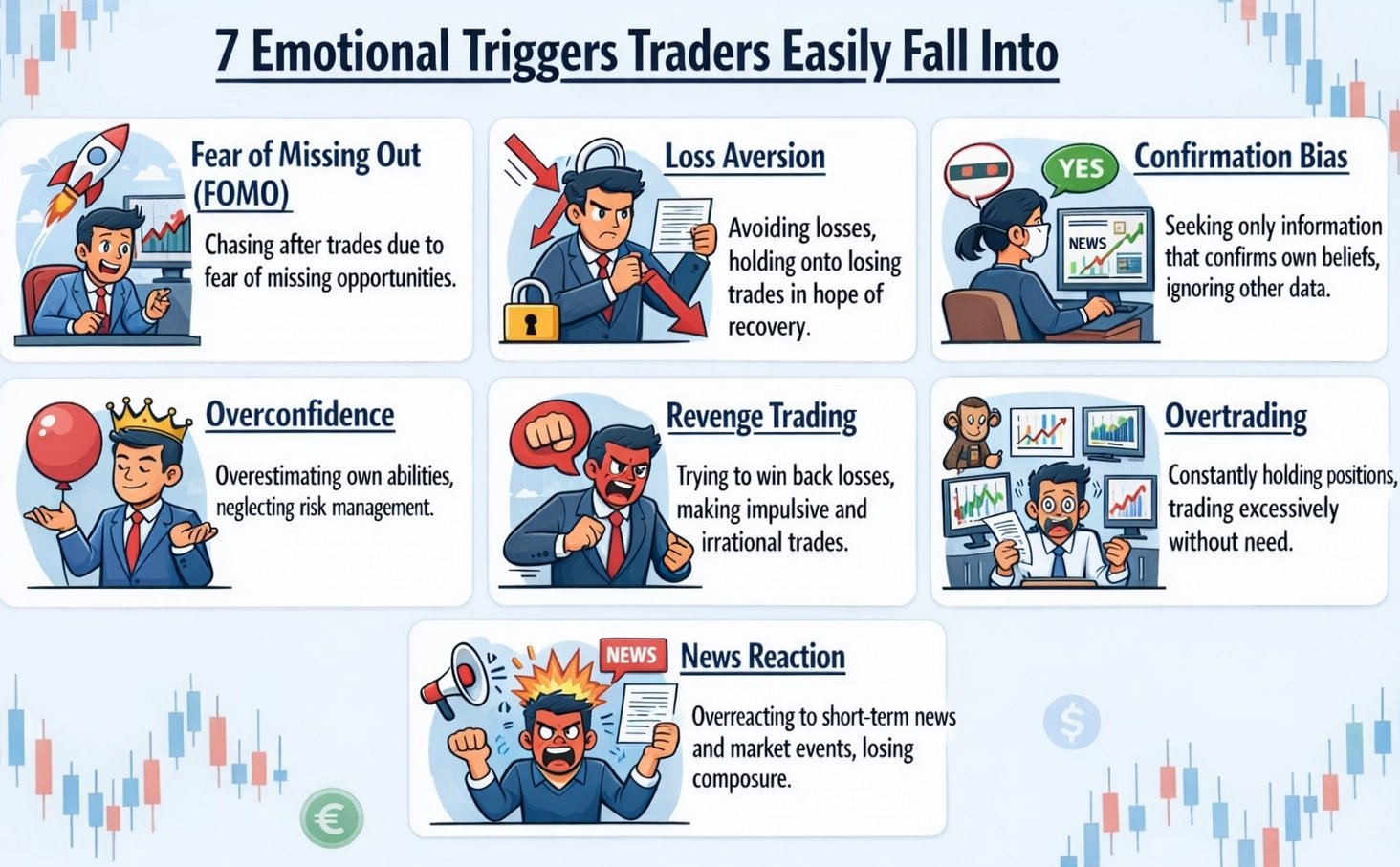
1) Fear of missing out (FOMO): “If I don’t enter now, it’s over”
When price suddenly accelerates and the chart starts running, you feel it in your chest.
“Oh no—it’s taking off… If I don’t jump in now, it’ll never come back!”
When that panic hits, people tend to prioritize speed over evidence.
The common outcome is chasing the top.
Momentum stalls, price snaps back, and you get stopped out quickly.
Then you fear being left behind again, so you repeat the same mistake.
2) Refusing to cut losses (loss aversion): “It’s not a loss until I close”
Watching a floating loss is painful.
“It’s not realized yet. A wick could bring it back. If I cut here, I’m admitting I lost…”
That feeling is normal—very human.
But the stronger it gets, the more it drags you toward late stop-losses.
What started as a small, manageable loss turns into “I’ll just wait until it comes back,” and the loss grows.
Across your trading record, this can ruin performance in just a few trades.
3) Confirmation bias (collecting convenient evidence): “I must be right”
The moment you open a position, you suddenly start checking social media and news.
And without noticing, you begin searching for opinions that match your trade.
“A famous trader sees it the same way—so I’m right.”
The danger is that you stop seeing warning signs.
Even if reversal signals appear, you dismiss them as “noise.”
That delays your exit and lets losses grow—this is confirmation bias at work.
4) The “I’ve got it” feeling after a win streak (overconfidence): “I can see the market today”
After two or three wins, your mood can spike.
“Today I’m locked in. I can go again.”
It feels like your judgment is sharper, but in reality it’s often the moment your caution disappears.
When confidence turns into momentum, you start doing things you wouldn’t normally do:
sloppier entries, wider stops, bigger size…
And then one loss wipes out all the earlier gains.
5) The urge to win it back (revenge trading): “That loss wasn’t fair”
After a run of stop-outs, your calm gets worn down.
“That wasn’t my fault. I’ll get it back with the next hit.”
When that emotion shows up, people prioritize speed of recovery over quality of setup.
Entries get sloppy, trades increase, and losses continue.
Before you know it, you’re not “recovering”—you’re expanding the damage.
6) Anxiety when you’re not trading (overtrading): “I haven’t done anything today…”
When the market is quiet for a while, you can start feeling uneasy.
“If I don’t do something, today will be a ‘no-trade day.’ I’ll just take something small.”
That mindset turns trading into busywork.
But there are days you shouldn’t trade, and times you should wait.
If you force trades, you rack up weak setups and small losses that quietly pile up.
7) Overreacting to news: “If I nail this, it’s huge”
Around major releases, the atmosphere changes. Social media heats up, rumors fly.
“This CPI feels like it’ll surprise. If I position right now, it could be massive.”
That excitement can steal your calm.
The issue is that with news, you can be right and still lose.
Spreads widen, slippage spikes, price whipsaws and reverses—difficulty jumps sharply.
That’s when you get accidents you don’t see in normal, steady trading.
What these 7 triggers share is simple: the stronger your emotions get, the more you prioritize “how it feels right now” over rules.
Each mistake may look small, but over time, it reliably drags down your long-term results.
Why emotion is your biggest enemy: expectancy collapses with small execution drift
Here’s the core point: the biggest enemy in trading isn’t the market—it’s emotion.
Even if a strategy has an edge, the moment emotion creates execution drift, your expectancy gets shaved down.
Markets are uncertain, and profits and losses arrive in a random-looking sequence. What makes it worse is that rewards (profits) often come with a delay.
In that environment, the brain leans toward avoiding short-term pain (loss and anxiety) and ends up choosing actions that feel better now over actions that are statistically correct.
1) Expectancy breaks from “tiny execution drift”
Expectancy (whether you grow over the long run) can be roughly expressed like this:
Expectancy = Win rate × Average win − Loss rate × Average loss
The key is that expectancy isn’t determined only by the strategy. It depends on what happens to average wins and average losses in real execution.
And emotion tends to worsen both.
- Late entries: fear makes you hesitate, you miss better prices, and average wins shrink
- Taking profit too early: you want relief, you miss the bigger move, and average wins shrink
- Late stop-losses: “It’ll come back” keeps you in too long, and average losses grow
When “average wins get smaller” and “average losses get larger” happen together, your edge fades fast.
You may still have winning days, yet your account slowly bleeds over time—what’s often called a negative drift.
That’s the scary part: emotion doesn’t always crush win rate dramatically. It quietly damages the P&L distribution (how you win and how you lose).
Related: FX Trading Expectancy (EV) Explained: EAs, Win Rate, Risk-Reward & Money Management
2) Drawdowns easily trigger an “emotion spiral”
When drawdown (DD) and losing streaks continue, confidence drops and your thinking becomes short-term.
Then many traders fall into a pattern like this:
Lower confidence → exceptions become acceptable → deeper drawdown
- Stop-losses feel scary: cutting a loss feels like self-rejection, so you delay realizing it
- You collect convenient reasons: confirmation bias delays exits
- You want to win it back: revenge trading increases trades and size, expanding losses
What makes this spiral dangerous is that your edge stops being the deciding factor—your psychological collapse becomes the driver.
And once you allow one “exception,” it often becomes the new rule. That’s the entrance to breakdown.
3) A time-horizon mismatch: short-term pain vs. long-term expectancy
Strategies with statistical edge often look unstable in the short term.
Win/loss streaks and clusters of losses are normal.
That’s why you need a long-term lens.
But humans react strongly to short-term losses and floating drawdowns and tend to undervalue long-term expected reward.
That leads to behaviors like:
- Quitting a strategy at the worst time: stopping right in the middle of a normal losing stretch
- Jumping to a new strategy: chasing whatever looks hot lately
In other words, you’re not only cutting trades—you’re cutting the strategy itself.
Statistically, the moment you most want to quit is often a “within expectations” rough patch, and the payoff may come later. Emotion doesn’t let you wait.
4) Stress responses distort decisions: body → decision-making
During sharp moves or growing floating losses, your body shows stress responses: faster heart rate, sweaty hands, shallow breathing.
In that state, your perspective narrows and decisions become extreme.
- You’re too scared to enter (or you enter late)
- You’re too scared to hold and take profit early
- You’re too scared to cut and can’t stop out
Even if you tell yourself “Stay calm,” your body reacts first.
That’s why trading is less about talent and more about repeatable execution (doing the same right actions again and again).
5) The stronger the emotion, the more you damage your account’s safety margin
When emotions spike, traders often drift in these directions:
- Position size increases (overconfidence after wins, or the urge to recover)
- Positions become concentrated (overexposure to one pair or one direction)
- Correlation increases (stacking essentially the same risk)
Then a move you could normally survive becomes a serious hit.
Emotion doesn’t just affect one trade—it can break the risk structure of your entire account.
Key takeaways
- Expectancy is decided by execution: if emotion shrinks average wins and expands average losses, the edge disappears.
- DD triggers an emotion spiral: panic → exceptions → deeper DD, until psychology controls outcomes.
- “Cutting the strategy” happens easily: short-term pain makes you switch at the worst timing.
- Emotion also reduces your safety buffer: bigger size, concentration, and higher correlation turn one loss into a major wound.
That’s why skilled traders prioritize not just “a strong strategy,” but execution that protects expectancy (execution where emotions don’t change average wins/losses).
The traders who keep winning put “discipline” first
What separates traders isn’t flashy strategies—it’s whether they can repeat the same rules with the same quality.
And discipline here isn’t about toughness. Discipline = a structure that keeps actions stable even when you feel things.
Fear, greed, and urgency will show up in markets. The problem isn’t feeling them. The problem is that when they show up, you delay stop-losses, take profit early, or increase size—and your expectancy breaks.
That’s why good traders build a stable execution template before they obsess over techniques.
Four steps to build discipline (Plan → Execute → Guardrails → Review & record)
- Plan (lock the rules)
Decide in advance what you trade: pairs, sessions, and “no-trade” hours.
Then define entry and exit (risk-off) conditions so you can explain them in plain words, and add numbers where possible to reduce ambiguity.- Entry example: “Break of the recent high” + “volume rising” + “moving average sloping up”
- Exit example: “Stop-loss = slightly below the recent low” / “Take-profit = 2× stop distance” / “Trail once price moves far enough”
- No-trade example: Don’t trade 30 minutes before/after major releases (like NFP)
- Execute (standardize the procedure)
The goal is to avoid improvising in the moment.
When you place an order, make it standard to place stop-loss (SL) and take-profit (TP) at the same time.
If possible, use IFD-OCO (conditional orders) to reduce the chance that manual emotion slips in.- IFD-OCO: “Enter if condition X happens, and once filled, place SL and TP at the same time.”
- Position sizing: decide “what % of the account you risk per trade,” then adjust lot size within that limit
- Guardrails (stop yourself before you spiral)
Emotions hit hardest during losing streaks, drawdowns, and “win it back” moments.
So set a pre-defined circuit breaker—a rule that forces you to pause.- Examples: stop for the day after a daily loss limit / stop after a losing streak / cap the number of trades per day
- Example: when you’re up on the day, reduce size so you don’t get reckless
- Review & record (confirm repeatability)
On a schedule (for example, once a week), review whether you followed your rules and log it.
The trick is to check rule adherence before P&L.- What to review: did you move stops? take profit earlier than planned? take unplanned entries?
- Also record “inner movement” like anxiety, urgency, revenge impulses, and fear-based profit-taking
Five principles that support discipline
- 1) Lose small, win bigger (cut losses, let winners run)
Win rate matters less than how you lose and how you win.
Accept small stop-outs and build a plan that captures bigger moves when they come. - 2) Prioritize quality over quantity
More trades don’t automatically mean higher expectancy.
“Not trading” can be a strong decision. - 3) After a good day, be extra careful
After a win streak, it’s easy to feel “I’ve got it,” and decisions get sloppy.
That’s why a “stop while you’re ahead” rule can work so well. - 4) Don’t create exceptions
Once you justify “This one time is special,” it becomes normal.
Discipline usually breaks first through “exception logic.” - 5) Record emotions, not just results
Before performance collapses, emotional warning signs almost always appear.
“I felt rushed,” “I was scared,” “I wanted it back”—one line like that often leads directly to your next improvement.
Remove emotion with EAs (automated trading) and execute your rules consistently
To keep winning, you need more than a “good strategy.” You need execution that doesn’t drift away from the rules.
That’s where EAs (Expert Advisors) can be powerful: they execute your plan without being swayed by hesitation, fear, or greed.
But there’s an important premise:
An EA doesn’t create a winning edge for you.
What an EA does well is execute an edge consistently.
In other words, long-term results require both a positive-expectancy logic × consistent execution.
Related article: What is an EA? How FX auto-trading works and how to choose one
What EAs can do (execution without emotional interference)
- Execute entry, stop-loss, and take-profit together: helps prevent mistakes like “I entered but forgot the stop” or “I moved the stop because I got scared.”
- Keep position sizing consistent: reduces blow-ups from increasing lots after wins or trying to recover after losses
- Follow trading hours and no-trade windows: easier to avoid “accident-prone” times like late-night trading or major news windows
- Stop when conditions get dangerous: can enforce rules like “pause after a losing streak” or “pause after hitting a daily loss limit”
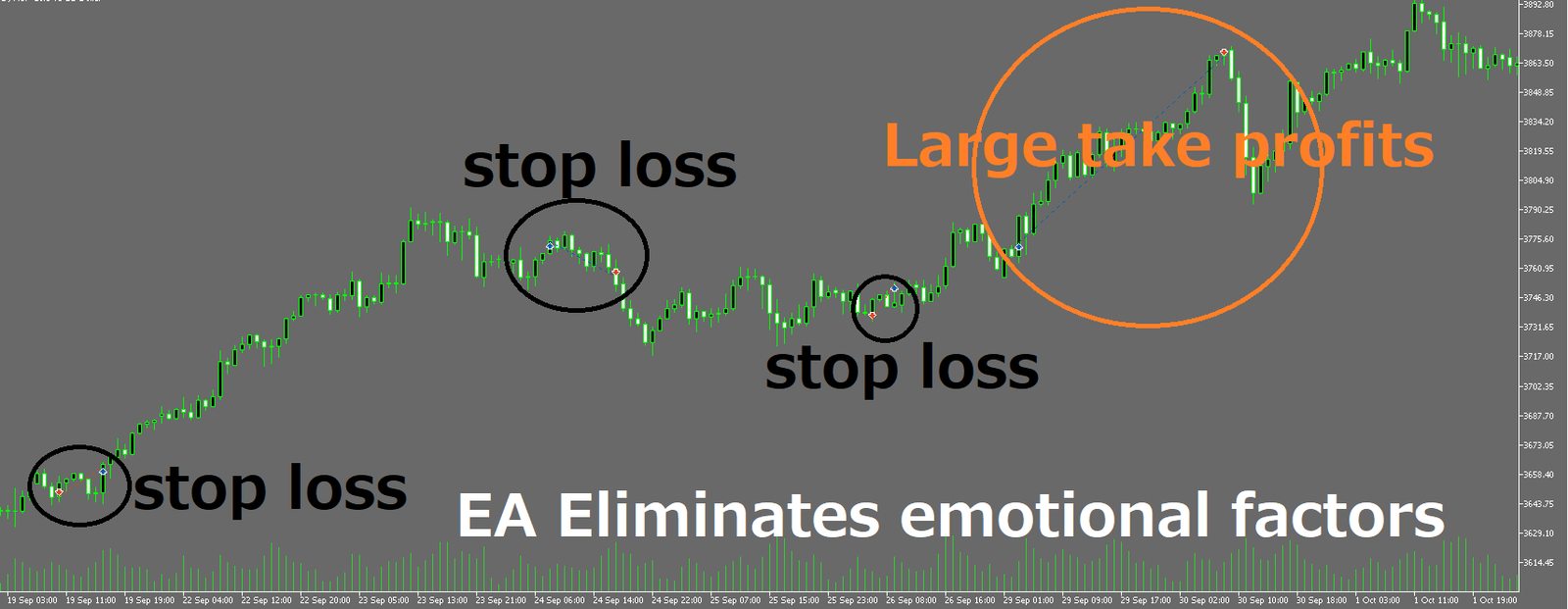
EAs are also great for testing whether your strategy actually has an edge
An EA’s advantage isn’t only removing emotion.
It’s also useful when you want to verify “Does this rule set truly have positive expectancy?”
The reason is simple: an EA can execute the same conditions, with the same procedure, repeatedly.
With discretionary trading, your entries and exits often change slightly based on mood or hesitation, which makes results noisy and inconsistent.
First, the premise: without an edge, discipline alone won’t make you profitable
Even perfect discipline can’t save a strategy with negative expectancy.
Beginners often break down for three main reasons:
- Vague rules: decisions change in the moment (“It feels like it’ll go up”)
- Not enough testing: mistaking a short hot streak for real skill
- Not thinking in probabilities: not planning for losing streaks and drawdowns, then blowing up mid-way
With an EA, it’s easier to lock rules and confirm outcomes in numbers.
Related: Trading Edge Explained: How to Build a Statistical Advantage in 4 Steps
Testing basics: backtesting and forward testing
- Backtesting:
Use historical data to see how the rules behave.
Short periods are risky—test as long as you can, ideally across multiple regimes such as trends and ranges. - Forward testing:
Test on out-of-sample periods not used in the backtest, and/or with a small live or demo account to confirm real execution and costs.
Think of backtesting as “desk work,” and forward testing as “field testing.”
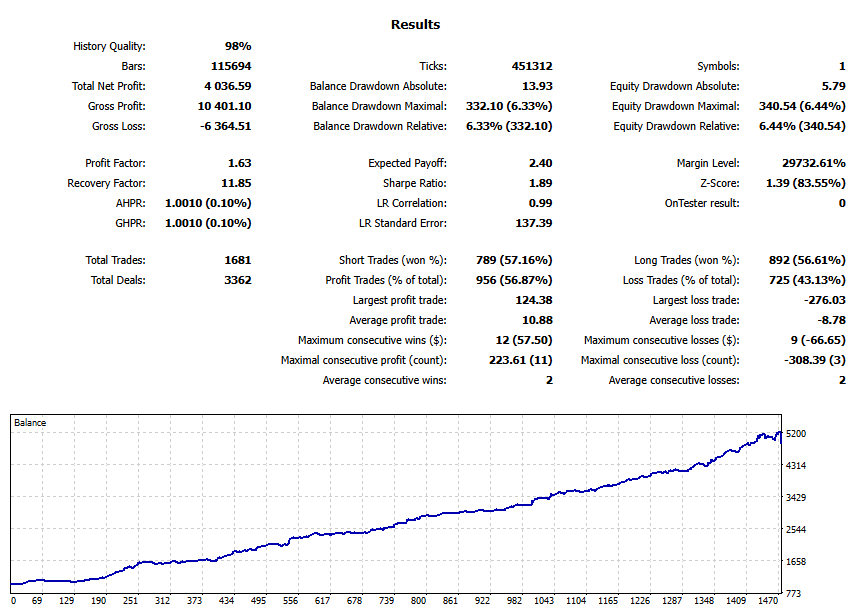
With backtests, you can evaluate an EA’s performance across past market conditions.
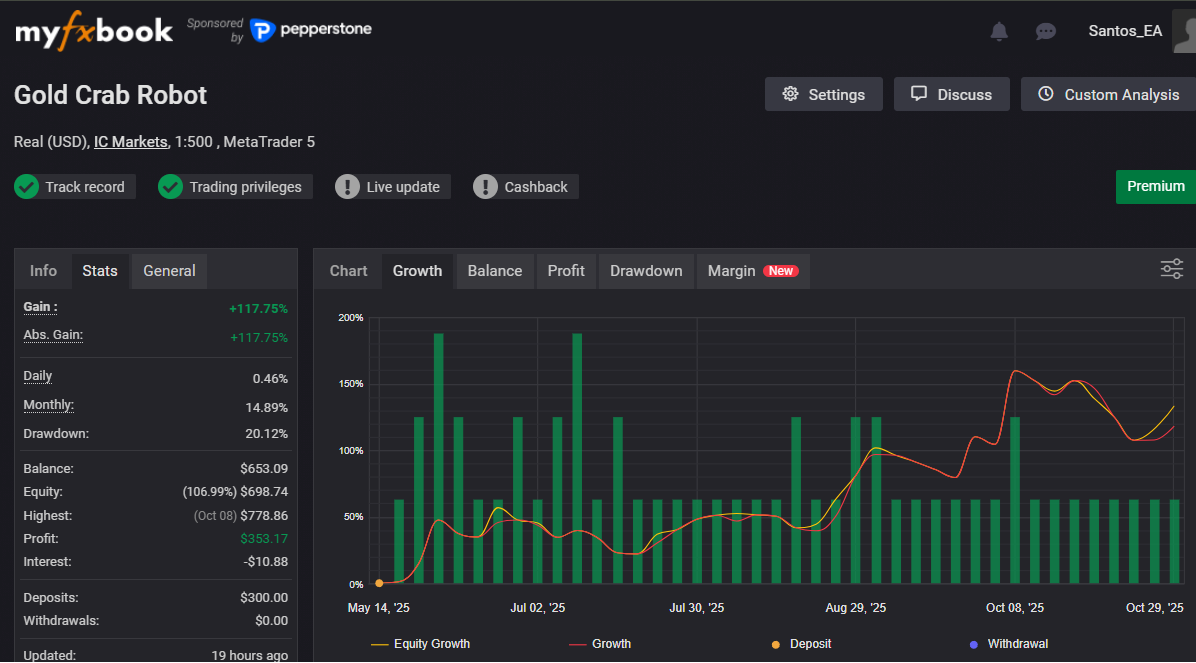
Some EAs publish forward-test results on third-party sites like Myfxbook.
Common pitfalls (don’t get careless—even with EAs)
- Over-optimization (curve fitting):
If you tune too tightly to “what happened to work” in the past, it often breaks in the future.
Be especially cautious with EAs that have too many parameters or overly complex rules.
See What is EA over-optimization (overfitting)?. - Unrealistic cost settings:
If you don’t model spread, commissions, slippage, and execution delay realistically, a backtest can look great while real performance disappoints.
Related: MT5 EA Trading Costs Explained: Spread, Commission, Slippage & Swap (Backtest vs Live Reality) - Risks when buying EAs:
It’s easy to make backtests and short forward tests “look good.”
If the equity curve is too smooth or metrics look unnaturally high, the EA may hide dangerous methods like grids, averaging down, or Martingale.
Be extra cautious when buying from a third party.
Special warning: risks of buying EAs (beginners are easily fooled by a “perfect upward curve”)
Let’s be blunt:
The newer you are, the easier it is to get hypnotized by a clean, straight-up equity curve.
Why? Because beginners often haven’t yet felt how normal market variance and P&L swings really are.
It’s easy to mistake low drawdown = safe.
But in reality, the EAs that look like they have almost no drawdown can be the most dangerous.
Because markets naturally fluctuate, and most normal, rule-based systems experience some drawdown.
If the curve looks “too perfect,” it may hide a high-risk structure such as:
- Grid / averaging down: adding positions while holding floating losses and “waiting for a bounce.” It can look smooth in calm markets, but a strong one-way trend can be fatal.
- Martingale: increasing lot size as you lose to “win it back.” It can look great short term, but carries a high risk of a major collapse.
- Stop-loss placed extremely far away (or effectively none): by not realizing losses, drawdown can look small on paper for a while.
- Cherry-picked good periods: short backtest windows, biased market conditions, or only showing favorable settings.
So the prettier the curve, the more likely it is you’re looking at an EA that “wins most days, then loses everything in one event.”
This is a classic trap, and beginners often don’t notice it until it’s too late.
Related articles:
Why Grid Forex EAs Blow Up: Hidden Drawdowns + Red Flags (Self-Made EA Test)
Martingale EAs: Why They Blow Up (Backtest Proof + Checklist)
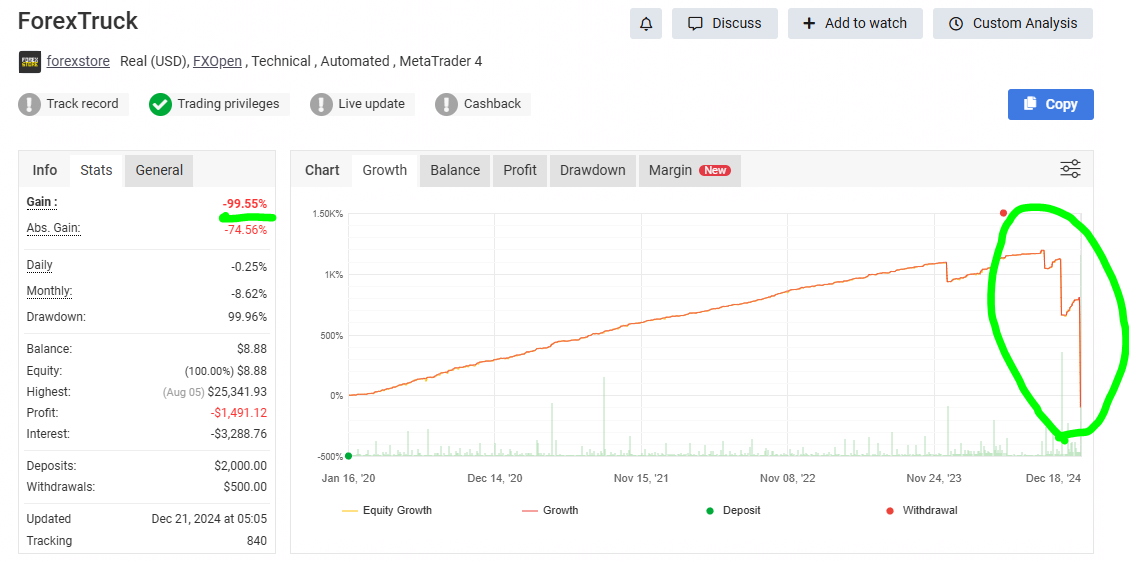
What makes it worse is the double hit you can take with purchased EAs:
you pay a high EA fee, then you also take a large trading loss.
That means you suffer both “the cost of buying” and “the cost of the collapse,” financially and mentally.
That’s why when you buy an EA, you shouldn’t ask “Is it winning?” first.
You should ask “How does it lose? How does it blow up?”
A clean upward curve is attractive—but when it’s too clean, be even more careful.
Minimum checklist before buying or deploying an EA (beginner-friendly)
It’s easy to make an EA “look profitable.”
So before buying, focus less on how it wins and more on how it loses (how it breaks).
Here are the minimum items you should check.
1) Any signs of averaging/grid/Martingale? (Verify via trade history)
Even if the equity curve rises smoothly, dangerous methods may be hidden.
Check the trade history for patterns like:
- Lot size increases after losses (possible Martingale or modified Martingale)
- Positions keep stacking in the same direction (possible grid/averaging down)
- Multiple positions closed at once at the same time (common in grid systems that “dump everything” to escape)
- Long holds of large floating losses followed by bulk closures (possible “wait for a bounce” structure)
2) Are win rate / PF too high? (Numbers that are “too good” are a red flag)
If the win rate is abnormally high or Profit Factor (PF) is unusually high,
it may indicate a structure that “wins most of the time, then occasionally collapses” (late or no stop-loss, averaging down, etc.).
Related:
» Stop Chasing Win Rate: How to Evaluate Forex EAs with Expectancy, Risk-Reward & Drawdown
» Profit Factor (PF) Explained: Why a High PF Doesn’t Mean a Safe Forex EA
3) Check R:R to understand how it wins and loses (small wins / big losses check)
R:R (Risk-Reward) = Average win ÷ Average loss.
The goal isn’t only “Is it profitable?” but how it profits and how it loses.
- Extremely low R:R (small wins, large losses) → likely to become small wins / big losses
- Many small wins, one huge loss (the classic “small wins, one big loss” pattern)
4) Check maximum drawdown (DD) and recovery time
DD is “how far it can fall,” and recovery time is “how long you must endure before it returns.”
Even if DD looks small, if the trade history suggests averaging/grid behavior, it can still be dangerous.
Related: EA Drawdown (DD) Explained: How to Read MT5 Reports, Focus on Equity DD, and Set a Risk Limit
5) Are losing streaks and flat periods realistic? (Would you quit mid-way?)
A system that makes you want to quit mid-way tends to fail in long-term operation.
Check how long losing streaks and stagnation can last, and whether you can handle it psychologically.
6) Is the number of trades (sample size) large enough?
Results with too few trades are heavily influenced by luck.
Don’t judge an EA based only on a short-term upward run.
7) Is it extreme scalping? (Lower repeatability)
Ultra-fast scalping that targets a few seconds to a few tens of seconds is strongly affected by spread, slippage, and execution latency.
Backtests can diverge from real results easily.
Be careful if profitability depends on a specific broker environment.
Related article: Scalping EAs: Why They Often Fail on Live Accounts (Costs, Slippage, Execution)
8) Can you confirm with backtest + forward test? (Are costs realistic?)
Is the testing done with realistic settings for spread, commissions, slippage, etc.?
If possible, confirm behavior via forward testing (demo/small live) and/or third-party tracking sites.
9) If you buy it, can you explain how it makes money?
At minimum, you should be able to understand from trade history and logic explanations “when it enters and how it exits.”
It’s dangerous to entrust capital to an EA you don’t understand.
Even with EAs, you still need emotion control: don’t “cut the strategy” during losing streaks
Because EAs place orders automatically, many people assume “emotion can’t interfere.”
But in practice, you still need emotion control with EAs.
That’s because emotion doesn’t affect entries/exits—it affects your decision to keep running the system or stop it.
A common pattern is stopping an EA after a losing streak or drawdown because it feels unbearable.
That’s not cutting a trade—it’s cutting the strategy.
Even if a strategy has positive expectancy, if you stop it during normal short-term variance, you may end it before the edge has time to show up.
It’s normal that losing streaks hurt: EAs can still drain you mentally
EA losing streaks can feel even tougher than discretionary trading because there’s “nowhere to run.”
Every loss adds another layer of “Is this EA okay?”
And the next loss makes you want to hit the stop button.
Countermeasure: compare to your tests and confirm whether it’s “within expectations”
When you feel like stopping, the best move is to avoid emotional judgment and return to data.
Check whether the current behavior is within the range shown in backtests (or forward tests).
- Losing streak length: did similar streaks happen in testing?
- Drawdown: where are you relative to the historical max DD?
- Stagnation period: how long can flat periods last by design?
The point is not to swing between excitement and panic based on short-term results, but to view the system as a long-term plan that includes variance.
An EA isn’t a “monthly profit machine.” It’s a mechanism that grows through ups and downs, driven by expectancy.
Warning: EA marketing hype targets your emotions
Sales pages often use language designed to push beginners into rushed decisions, such as:
- “Price goes up if you don’t buy now”
- “Only ◯ units left”
- “Limited-time special price”
- “Anyone can earn stable monthly profit easily”
These tactics are meant to make you act fast and skip calm verification (history checks, risk understanding, etc.).
What you need for EA trading isn’t “buying in a hurry.” It’s understanding expectancy and risk, and setting conditions you can run long term.
Conclusion: don’t try to “beat” emotions—build a system that doesn’t break when emotions appear
Trading losses aren’t only about whether a strategy is good or bad.
More often, execution drift caused by emotion (late entries, taking profit early, delaying stop-losses, revenge trading) chips away at expectancy and destroys long-term performance.
The human brain naturally leans toward “avoid short-term pain” and “secure immediate relief.”
In an uncertain market, that reaction shows up automatically.
So the goal isn’t to eliminate emotion—it’s to build execution that doesn’t change even when emotions show up.
- Expectancy breaks from tiny execution drift: the same strategy loses long term if average wins shrink and average losses expand
- Losing streaks and DD trigger emotion spirals: panic → exceptions → deeper losses is the most dangerous failure mode
- Even with EAs, emotion control matters: stopping the EA = “cutting the strategy,” which can kill the edge before it appears
- Be suspicious of “perfect upward curves” when buying EAs: dangerous structures like averaging/grid/Martingale may be hidden
In the end, profitable traders keep it simple:
Prepare a positive-expectancy rule set, test it realistically with costs, accept normal variance, and execute consistently.
That ability to “keep going by design” is the real core of emotion-proof trading.
 MQL5
MQL5
 Myfxbook
 YouTube
 X
X
 GOGOJUN