

Which is better: discretionary trading or automated system trading (EAs)?

Bottom line: if you want to test a strategy and build consistent, repeatable results, system trading with an EA tends to have the advantage.
But there’s one non-negotiable requirement: the strategy must have an edge. If an EA has no edge, running it “with discipline” just means it will rack up losses in a perfectly mechanical way.
What matters even more is this: don’t get fooled by “too-perfect” performance when buying an EA.
Many traders pay a high price after getting drawn in by a smooth equity curve or an unusually high win rate—then take a big hit in real trading.
In this article, you’ll learn the key differences between discretionary trading and EAs, plus practical checkpoints to avoid dangerous EAs.

System trading (EAs) often wins when you combine “edge testing” with “repeatable execution”
The key to staying profitable in trading is simple: repeat an edge (a strategy with an advantage) without wavering.
Flip that around, and it’s just as simple: even if you execute with perfect discipline, a strategy with no edge will only pile up losses.
So the first step is always the same: verify whether the strategy actually has an edge.
That’s where backtesting (testing on historical data) and forward testing (confirming repeatability in live or demo conditions) are powerful.
Once you can confirm the edge with numbers, you can repeat the same strategy with a real reason—not just a “feeling.”
Because EAs make it easier to create this flow—“testable” → “repeatable without emotions”—system trading often has an advantage.
With an EA, you codify the rules and execute them the same way under the same conditions, which leaves far less room for hesitation or inconsistency.
That said, an EA is not a “buy it and print money” tool.
A common trap for beginners is getting attracted to a too-smooth upward equity curve or a very high win rate,
buying an expensive EA, and then suffering a large loss in real trading.
EA trading also comes with real-world burdens: over-optimization (curve fitting) risk, 24/7 PC/VPS operation, and fixed costs.
So keep this in mind from the start: EAs are strong at testing and repetition, but a poor choice or weak operating setup can be dangerous.
Related article:What Is a Forex EA (MT4/MT5)? An Automated Trading Guide
What is discretionary trading? (Quick overview)
Discretionary trading is a style where you decide entries and exits by watching the chart and making real-time judgments.
It lets you use experience, intuition, news, and market “feel,” but the biggest challenge is that decisions can drift, and it’s hard to make the process repeatable.
Pros of discretionary trading (strengths)
Pro 1: Easy to start (almost no setup)
With discretionary trading, you can start as long as you have a platform where you can view charts.
Unlike EA trading, you don’t need to build and maintain an “ops” environment—like always-on PC/VPS, reboot protection, or log monitoring—so
the barrier to entry is low.
Pro 2: You can respond to market changes with a human interpretation
Discretionary traders can factor in context: market tone, news/events, and how price moves during sudden volatility.
For example, you can avoid choppy conditions around major economic releases, or skip trading when you see abnormal spread widening.
This kind of situational judgment is a major advantage.
Pro 3: Skill improvement directly turns into an edge (your judgment stacks over time)
As you gain experience, you tend to improve at “knowing when not to trade,” cutting losses, and reading market regimes.
Those skills can show up in your results.
However, if you rely only on gut feel, repeatability breaks down—so keeping records and reviewing becomes essential.
Cons of discretionary trading (challenges)
Con 1: Hard to test strictly (backtests are difficult to reproduce)
Because discretionary trading makes it hard to perfectly repeat “the same decision under the same conditions”,
it’s tough to backtest in a strict, objective way.
Even on the same chart, your decisions can change based on your mood, energy, or focus, which makes results harder to build up consistently.
Con 2: Hard to isolate your edge (what exactly made you win?)
Small differences in entries and exits add up, so it’s often difficult to break down what contributed to profits in numbers.
If the reason you won is unclear, it’s also harder to improve when market conditions change.
Related:Trading Edge Explained: How to Build a Statistical Advantage in 4 Steps
Con 3: Emotions can break your rules (rule drift happens easily)
Frustration after a losing streak, overconfidence after wins, noise from social media—emotions are often the biggest factor that ruins performance.
Discretionary trading is hard because “I knew better” still happens.
Related:Emotions in Forex Trading: 7 Triggers That Break Your Rules (And How to Fix It)
Con 4: It can take more time (you must watch and decide)
Because you need to make decisions, discretionary trading often increases the time you spend watching the market.
It can also be affected by your lifestyle, sleep, and focus, which can make long-term consistency harder.
Note: To win more consistently with discretion, focus on “rules, records, and testing”
To keep the flexibility of discretionary trading while reducing inconsistency,
you need to lock your decision criteria into written rules and run a cycle of record → review → improve.
Pros of system trading (EAs)
System trading turns your entry/exit rules into code or logic, then follows the order of test (backtest) → run (forward test).
Because it’s a numbers-driven world, the biggest benefit is that it’s much easier to build repeatability.
Pro 1: Remove emotions and enforce discipline
The biggest advantage is that you can block emotions at the entry point.
Execution is mechanical and rules don’t change—so you can focus on testing and improving.
Pro 2: Automation gives you more freedom with your time
Because EAs can trade automatically, you don’t need to stay glued to the chart.
The EA can follow your rules while you work or sleep (though monitoring is still recommended).
Pro 3: Backtests help you build numerical proof
Beyond win rate, you can measure risk-reward (average win vs. average loss), maximum drawdown (DD), losing streaks, and expectancy.
Instead of “I feel like it wins,” you can explain “this setup tends to win under these conditions”.
Note: EAs come with strong temptations (so you need checks)
EAs are often marketed as “automatic income” or “profits while you sleep,” which can be especially tempting for beginners.
That’s why many people choose based only on looks and miss the risks—so you must be careful.
Cons of system trading (EAs)
Con 1: Easy to fall into over-optimization (overfitting)
Because you can optimize EA parameters easily, it’s also easy to go too far and create great-looking performance that only works in the past.
Many EAs fail in live markets for exactly this reason.
To reduce this risk, do checks like forward testing, long-period backtests, and cross-testing on other currency pairs.
Related article:What is EA over-optimization (overfitting)? How to spot it + a pre-purchase checklist
Con 2: You need 24/7 PC/VPS operation (the reality of running an EA)
To run an EA, you typically need an environment where a PC or VPS is always on.
If the PC/VPS powers off, sleeps, reboots, updates the OS, or MT5 goes down, the EA stops too.
You need to build a stable operating foundation.
Related:Cheapest VPS for MT4/MT5 EAs: Windows Plans, Latency, and Total Monthly Cost
Con 3: Fixed costs are common (VPS fees and maintenance)
EAs are convenient, but they often come with fixed costs like VPS monthly fees.
With fixed costs, small profits can get wiped out by expenses.
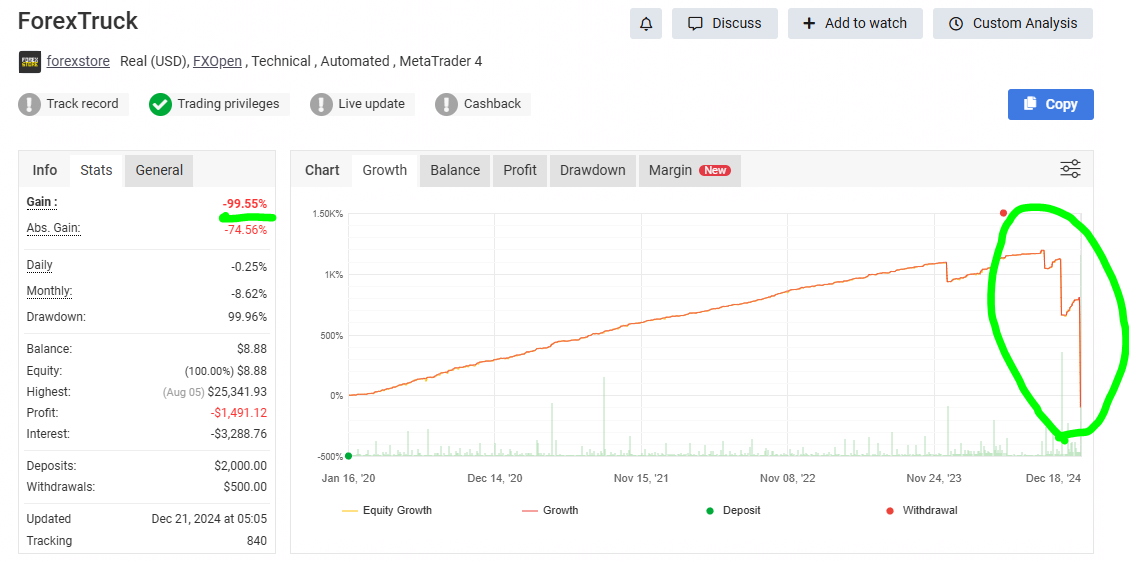
Con 4: The trap of buying EAs (watch out for “too-smooth equity curves” and “very high win rates”)
If you buy an EA, the biggest danger is getting fooled by performance that looks great.
A perfect upward equity curve and an unusually high win rate can look very attractive, especially to beginners.
In reality, many of these EAs hide risky logic such as grid averaging (adding positions as price moves against you) or martingale (increasing lot size after losses).
They can keep a high win rate by holding large unrealized losses.
The common outcome is expensive purchase → one sharp move → huge loss.
Important: Be extra careful with grid averaging and martingale
Grid averaging and martingale can make win rates and equity curves look clean in the short term,
but when the market trends strongly in one direction, losses can grow fast.
If the EA design is “hard to stop,” has “no real stop-loss,” or keeps increasing lot size, it can become a fatal blow sooner or later.
If you spot these features during testing or live operation, don’t bet on “it will come back.” Consider stopping or exiting.
Related articles:
» Why Grid Forex EAs Blow Up: Hidden Drawdowns + Red Flags (Self-Made EA Test)
» Don’t get fooled by martingale EAs: blow-up risks and how to spot them (with testing)
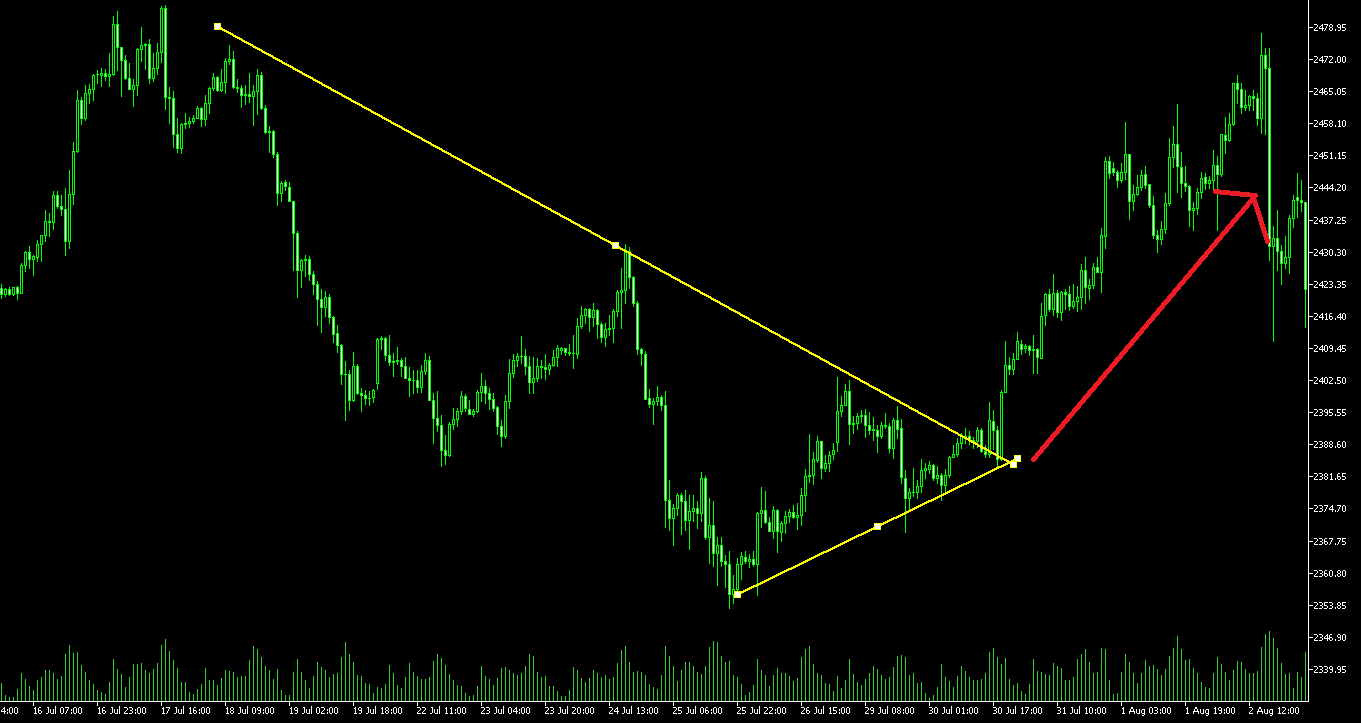
Where system trading struggles: the “fuzziness” of chart patterns
System trading (EAs) usually makes decisions using numbers and indicators (MA, RSI, ATR, etc.).
That means your rules must be “expressible as formulas” and “clearly separable into conditions.”
But many chart patterns used in discretionary trading—like triangles, head and shoulders, and double tops—often include
visual interpretation.
That’s what makes full automation difficult.
Why are chart patterns hard to automate? (3 reasons)
Reason 1: People draw lines differently (the definition shifts)
Even with a simple triangle, traders may connect different highs/lows, include or exclude wicks, or choose different lookback windows.
On the same chart, it can look like “a different pattern.”
Humans can accept “roughly around here,” but EAs can’t tolerate ambiguity, so you must lock in a strict definition.
Reason 2: Breakout confirmation is vague (false breakouts happen often)
A discretionary trader can judge candle momentum, volume (in FX, usually tick volume), recent price action, and news to decide,
“this looks real” or “this looks suspicious.”
But an EA needs mechanical rules like:
close beyond the line = breakout, break by X pips = breakout, stay above for N candles = breakout.
Results can change dramatically depending on how you define it.
Reason 3: The same shape can mean different things in different market regimes
The same triangle can produce more false signals in a range market, but extend further in a trending market.
Expectancy changes with market regime (volatility, trend strength).
A discretionary trader can say, “the environment is bad, I’ll skip,” but an EA must include regime rules as part of the system.
To use patterns in an EA, you need quantification and repeatable rules
For example, to automate a triangle pattern, you’d need to decide numerical rules like (examples):
- How to pick highs/lows: use swing highs/lows from the last N candles, etc.
- How to define convergence: lower highs and higher lows continue for at least M occurrences
- How to approximate lines: use linear regression to calculate upper/lower boundaries, etc.
- How to confirm breakout: close above the line and exceed X × ATR
- Invalidation rules: exit if it doesn’t move within a time limit / stop out if price reverses
Only after you define these can the EA reproduce the same conditions every time.
But the more you define, the more parameters you add—and the risk of overfitting rises—so forward testing becomes even more important.
Conclusion: Patterns can be automated, but removing ambiguity increases difficulty and risk
You can automate chart patterns with an EA.
But you must replace discretionary “feel” with strict numerical rules for definition, confirmation, invalidation, and market regime,
which increases design complexity.
So if you’re a beginner and want stability with EAs, you’re usually better off starting with
rules that are easy to quantify rather than pattern recognition.
How to confirm an edge: backtest, forward test, and expectancy
An EA only shows its real value when the strategy has an edge.
And you confirm that edge with numbers, not vibes.
The key is not “does it look like it goes up,” but why it wins (the profit structure).
Even if an equity curve looks smooth, an EA that hides large unrealized losses using grid or martingale logic can
suddenly take a major hit one day.
Big picture for edge confirmation: BT → FT → (how it breaks) → decide whether to continue
For beginners who want a safer process, this order works well:
- Create a numerical base with a backtest (BT)
- Confirm repeatability in the future with a forward test (FT)
- Check not only performance, but also how it breaks, DD quality, and how unrealized losses build up
- Finally, judge with all costs included (spreads, commissions, VPS fixed costs)
Backtesting: build the numerical base with historical data (key metrics to check)
In a backtest, don’t look only at win rate. Check risk-reward (average win vs. average loss), maximum drawdown (DD), losing streaks,
and also trade count and test duration.
Why “win rate only” is not enough
Win rate is easy to “pump up.” A classic method is delaying stop-losses or holding floating losses,
so you avoid realizing losses and keep the win rate high.
These systems can look great—until a sharp move causes a major blow-up.
What matters most in a backtest
- Max DD: not only the size, but also when it happened and how long it lasted
- Risk-reward (average win vs. average loss): watch for small wins and large losses (the higher the win rate, the more cautious you should be)
- Losing streaks (max streak and frequency): can your account and your mindset survive it?
- Trade count: too few trades may just be luck
- Test period: check for biased conditions (only a strong trend phase, etc.)
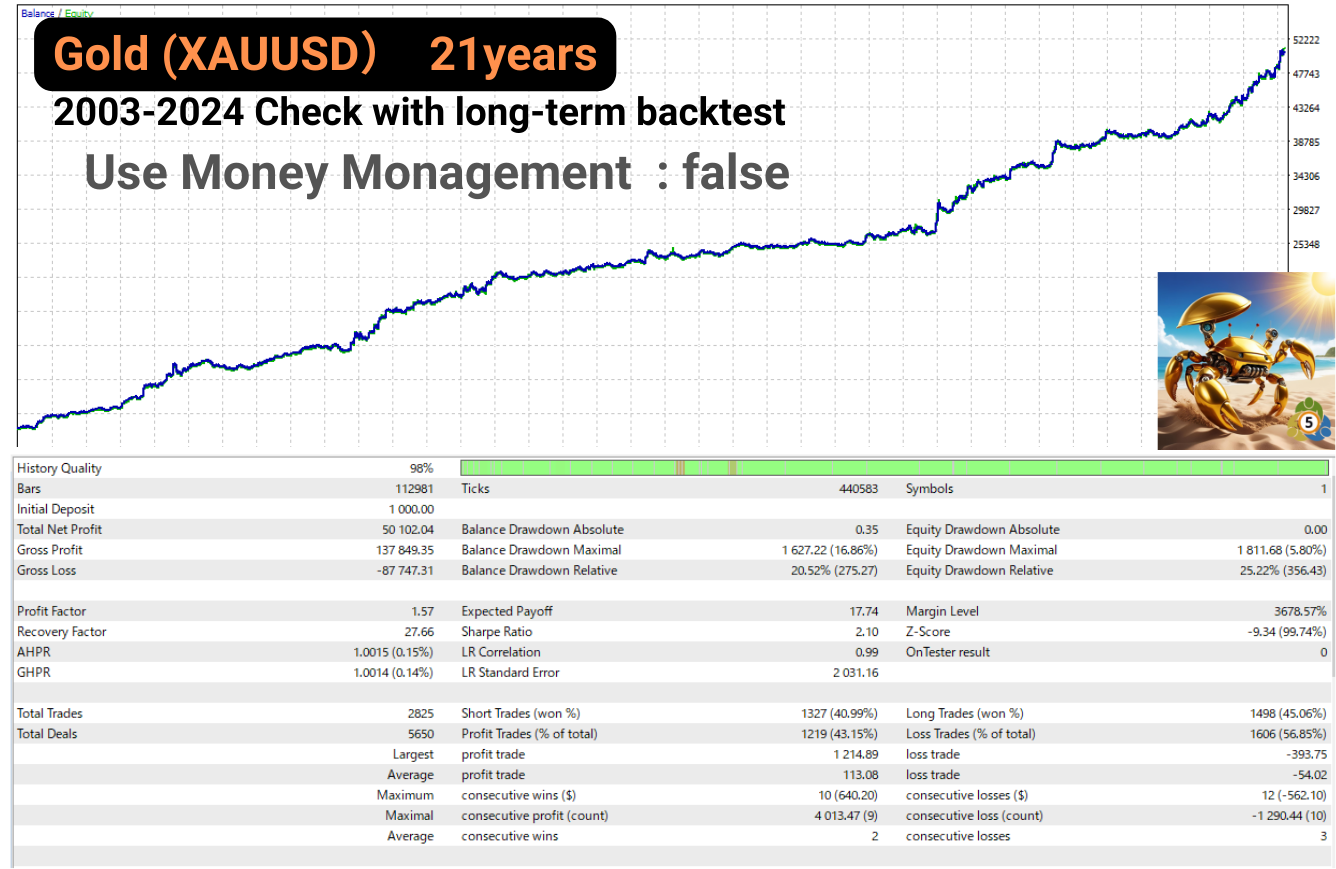
Related:How to Read MT5 Backtests: Verify EA Risk with Equity DD & Orders/Deals
Forward testing: check repeatability in live conditions (spotting overfitting)
Forward testing means running the EA on a demo or live account to see whether backtest results repeat.
If performance breaks here, there’s a strong chance the EA was overfit (curve fit).
In forward tests, don’t only watch “profit”—watch “how it breaks”
What matters in forward testing isn’t just whether it’s up or down.
It’s how losses appear (DD quality).
If you see behavior like this, it’s worth suspecting dangerous logic (grid/martingale):
- Unrealized losses don’t get realized for a long time (stop-loss isn’t working)
- Lot size increases after a loss (possible martingale)
- Positions keep stacking up (possible grid)
- One sharp move destroys the equity curve (the “fatal blow” pattern)
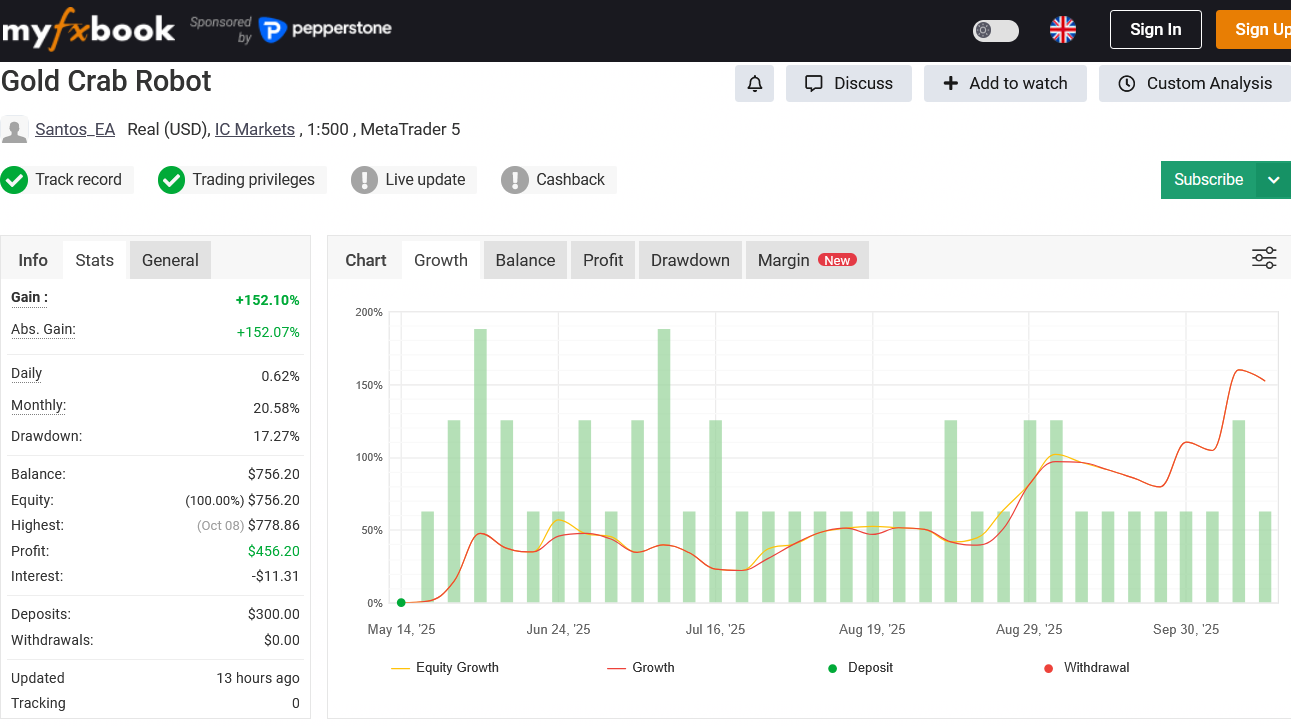
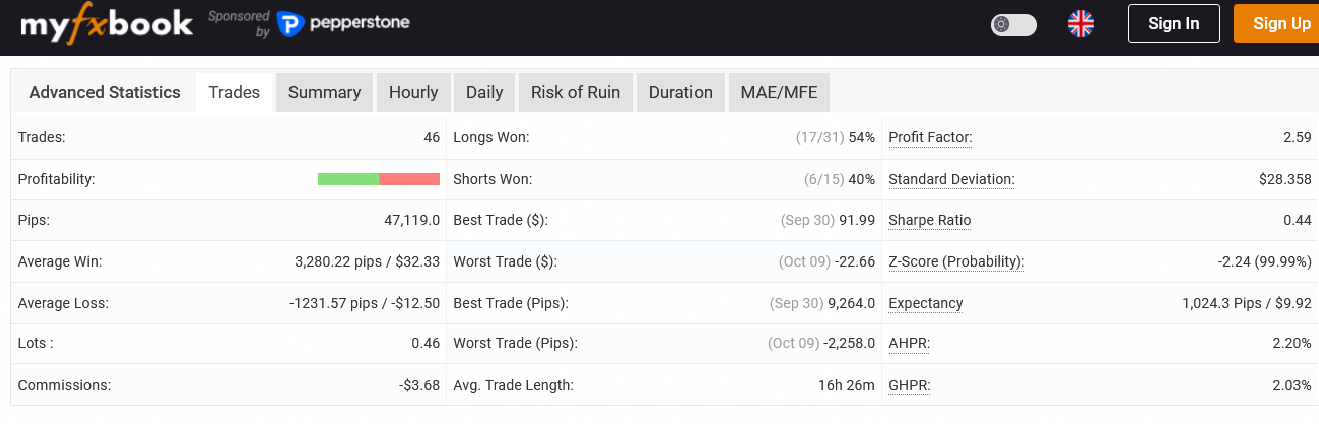
Related:How to Read Myfxbook: Spot Risky EAs (Balance vs Equity, Margin Spikes, Trade History)
Expectancy basics: Expectancy = (Win rate × Avg win) − (1 − Win rate) × Avg loss
Make sure expectancy is positive.
An edge is an advantage you can explain with numbers.
Even with a high win rate, if your average loss is big, losing overall is completely normal.
Note: Don’t underestimate “average loss” just because win rate is high
A common beginner mistake is thinking “high win rate = safe.”
In reality, strategies with high win rate but large average losses can be the most dangerous.
(They win small most of the time, then occasionally lose big and give everything back.)
Checklist to avoid dangerous EAs (always do this before buying)
If you buy an EA, check these points as a set.
If even one applies, you should do deeper research (confirm logic, verify forward results) or skip it.
- The equity curve is too perfect (DD is unrealistically small / straight line)
- Win rate is unusually high (is average loss huge?)
- It keeps holding unrealized losses (not realizing losses = blow-up risk)
- Lot size increases after losses (possible martingale)
- Positions keep increasing (possible grid averaging)
- Very tight scalping targets (weak to costs and slippage, often harder to reproduce)
Conclusion: Judge an EA by its structure and risk—not by how it looks
EAs are powerful because you can verify an edge with backtests and forward tests, then execute the same rules consistently.
But with purchased EAs especially, don’t get distracted by win rate or a pretty equity curve.
You must evaluate the risk structure too—DD, average win/loss, unrealized loss behavior, lot increases—and
how it fails when things go wrong.
Comparison table: Discretionary trading vs. system trading (EAs)
| Point | Discretionary trading | System trading (EA) |
|---|---|---|
| Testing (repeatability) | Difficult (hard to reproduce identical conditions) | Easy (numerical testing with BT/FT) |
| Emotions & discipline | Easily affected by emotions | Emotions removed / discipline enforced |
| Time required | Tends to require watching | Automation reduces screen time |
| Infrastructure | Minimal | Requires always-on PC/VPS |
| Costs | Relatively low | Fixed costs are common |
| Main pitfalls | Rule-breaking / emotions | Overfitting + buying risky EAs (grid/martingale, etc.) |
Summary: EAs can be an advantage—but if you can’t spot risk, they can lead to big losses
Discretionary trading is appealing because you “win with your own decisions,” but it tends to be weak in testing and repeatability, and it’s easily affected by emotions.
System trading (EAs) often has an edge in repeatability, discipline, and automation, but only if the strategy has an edge. It also comes with burdens like over-optimization, always-on PC/VPS, and fixed costs.
Most importantly, be careful not to get drawn in by a too-smooth upward curve or a high win rate when buying an EA.
Many traders overpay for risky grid/martingale-style EAs and then suffer one sharp move that causes a major loss.
Because EA trading comes with strong temptations, judge systems by risk structure, not appearance.
The key to long-term success is edge × testing × discipline, plus a safety design that includes clear stop criteria.
FAQ
- Q. Is a high-win-rate EA always good?
- A. Not necessarily. Even with a high win rate, if it has large average losses or holds unrealized losses, one sharp move can cause a big hit.
- Q. Are grid averaging and martingale always bad?
- A. The risk is very high, and they’re especially dangerous for beginners. Even if you use them, if you don’t have clear stop criteria, you should consider stopping.
- Q. What’s the minimum I should check before buying an EA?
- A. Check max DD, average win and average loss, whether it holds unrealized losses, and lot increases (possible martingale).
- Q. What environment do I need to run an EA?
- A. Typically you need an always-on PC/VPS, a stable connection, reboot protection, a monitoring routine, and log/update management.
- Q. How do I confirm an edge?
- A. Use backtests and forward tests to confirm positive expectancy, acceptable DD, and a healthy profit structure (risk-reward = average win ÷ average loss).
 MQL5
MQL5
 Myfxbook
 YouTube
 X
X
 GOGOJUN