

Can scalping EAs actually make money?
The demo and backtest look great—but is it true they fall apart on a real account?

Bottom line: the results aren’t reliable, so I generally don’t recommend them.
Scalping EAs target profits of only a few pips, so their edge can disappear just from spread, commissions, and slippage. On top of that, broker-specific factors like execution rules and latency hit them directly.
As a result, performance on backtests or demo accounts often doesn’t carry over to live trading.
In this article, I’ll explain why scalping EAs break down, share a checklist to spot red flags before you buy, and outline alternative criteria that tend to be more reproducible.

What Is a Scalping EA? (How Ultra-Short-Term Trading Works)

Scalping EAs are automated trading systems that open and close trades in seconds to minutes, aiming to capture just a few pips many times over.
Because wins can come in streaks, backtests and forward tests may show a clean, steady upward equity curve.
Related: What Is an EA? How FX Trading Robots Work and How to Choose One
Why “It Looks Profitable” Can Be Misleading
Because the profit target is tiny, even small differences in real trading conditions can be fatal. The biggest drivers are:
- Trading costs: spread, commissions, slippage
- Execution conditions: rejections, last look, freeze level, and other broker rules
- Latency: VPS/network delays and distance to the broker’s trading servers
On demo accounts or under certain backtest settings, these factors are often underestimated. Then an EA that “looks like a winner” can collapse the moment you move it to a live account—simply due to wider spreads, more slippage, and slower fills.
In other words, scalping EAs don’t live or die only by “how smart the logic is.” Results can change drastically depending on the broker and your setup.
Next, I’ll explain why reproducibility is low and what you can check before buying.
Why Scalping EAs Struggle (The Real Reasons Results Don’t Repeat)
Scalping EAs target profits of only a few pips, so even minor differences in conditions can swing performance.
Below is a beginner-friendly breakdown of why demo/backtest results often fail to repeat on a live account.
1) Different brokers can produce totally different results (strong broker dependency)
- Execution details—STP/ECN, A-book/B-book, freeze level, and whether the broker uses last look—can change slippage and fill quality.
- It’s not unusual for the same EA to win with Broker A and lose with Broker B.
- Be cautious when forward tests are run on an unknown broker. Sometimes special conditions can make results look better than they would be in normal live trading.
2) Demo accounts often give “too good” fills
- Demo accounts can behave better than real trading: less slippage and fewer rejections, for example.
- Once you move to live, slippage, re-quotes/rejections, and spread widening increase—and profits that existed on demo can vanish.
3) Latency can erase “a few pips” in an instant
- Because the target is so small, latency (delay until execution) hits scalping directly.
- For example, a low-latency setup (a few ms) versus a high-latency setup (hundreds of ms) can lead to very different fill prices. A 2–3 pip target can easily turn negative after slippage.
- Even with a fast VPS, latency won’t improve much if the broker’s servers are far away.
4) The more trades you take, the more likely you lose to costs
- In scalping, spread + commission + slippage can eat most of the profit.
- If total cost per trade is 2.0 pips and the take-profit is 3 pips, you may keep only around 1 pip in practice.
- With hundreds to thousands of trades per month, many scalpers start by trying to earn back costs before they’re truly profitable.
5) Increasing lot size often makes results less repeatable (partial fills and extra slippage)
- An EA may look fine at small size, but once you scale up, you may see more partial fills, slippage, and rejections, and performance can break down.
- “It worked with small money, but stopped working when I increased size” is a common pattern in scalping.
6) “Quiet hours” can mean wider spreads
- Late-night/early-morning sessions and the periods around major economic releases can trigger sudden spread widening.
- Because the profit target is tiny, even a modest spread increase can push expectancy below zero.
7) Backtests often assume conditions that are too favorable
- If a backtest uses fixed spreads, zero slippage, and no execution rejects, it’s far more favorable than real trading.
- That can create a smooth equity curve that “looks tradable,” even though live results won’t match.
Summary: The biggest weakness of scalping EAs is that outcomes depend heavily on external conditions—broker execution, costs, and latency—more than many traders expect.
Next, we’ll look at a real-world example where a demo account looked great but a live account broke down.
Case Study: A Scalping EA That Looked Great on Demo, Then Fell Apart on a Live Account
Here we’ll use publicly available forward results (from a third-party tracking site) to review a common pattern:
“The demo equity curve climbs smoothly, but the live account breaks down.”
The red boxes in the screenshots highlight key points such as whether the account is demo or live and how tiny the profit per trade is (pips).
① Demo account: a smooth upward equity curve
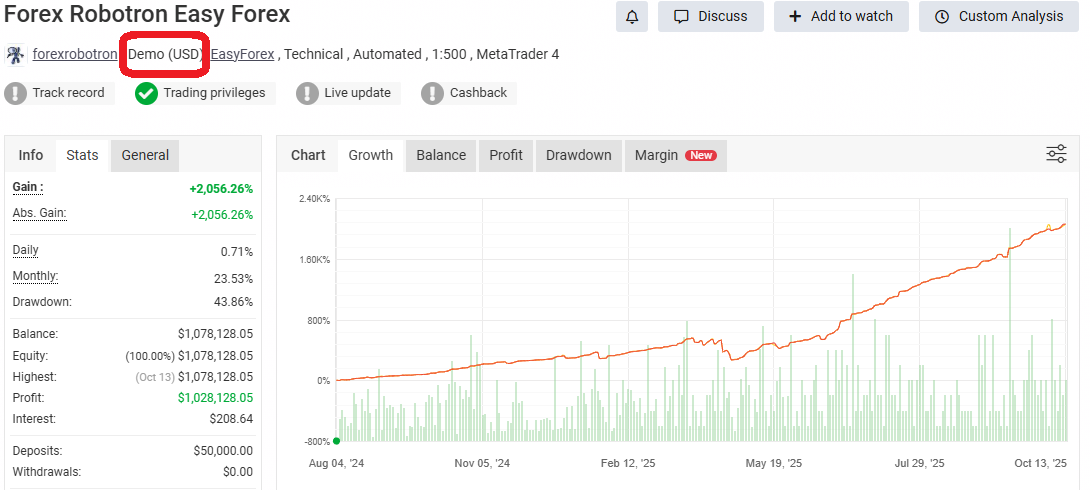
- The key detail is that the account type is “Demo.”
- Demo accounts can have better fill behavior than live trading—such as less slippage and fewer rejects.
- Because scalping targets thin profits of just a few pips, even a slight “demo advantage” can make the equity curve look too smooth.
② Trade history: most trades close within 10 pips (tiny take-profits)
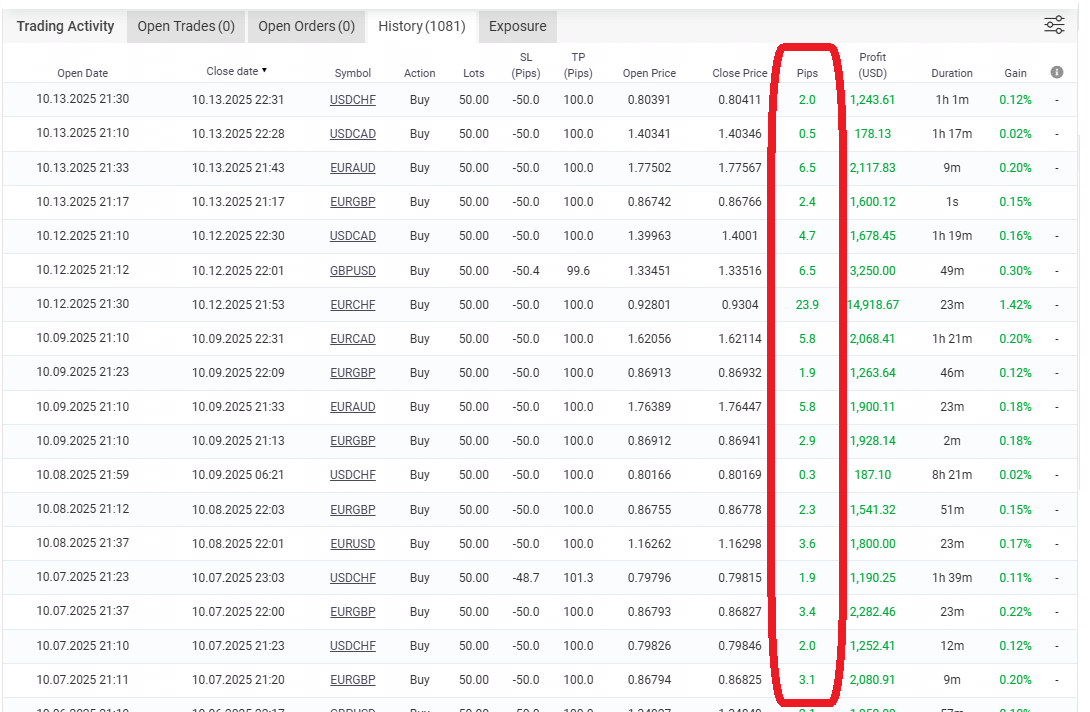
- The smaller the profit target, the more impact you get from spread + commission + slippage.
- Even if demo results look good, live trading can add slippage and spread widening, which quickly erodes profits and can flip expectancy negative.
- Also, when you increase lot size, partial fills and extra slippage become more likely, making it harder to reproduce the same results.
③ Live account: good start, then prolonged drawdown and stall
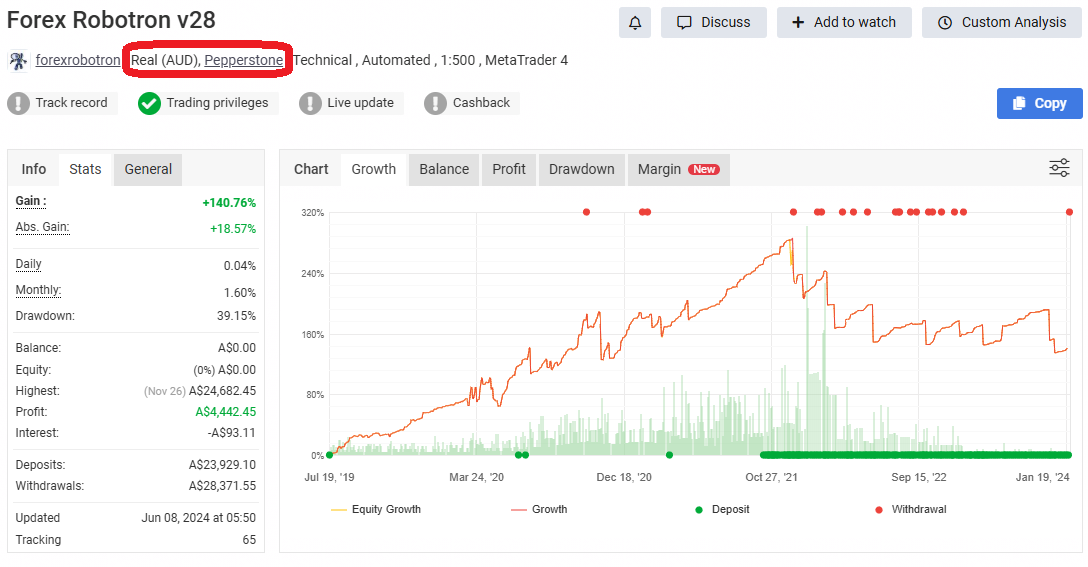
- On live accounts, real-world factors show up: latency, last look, freeze level, and spread spikes around news.
- With tiny profit targets, these “execution realities” effectively act like extra cost and can wipe out the thin edge.
- This is how the same EA can win on demo but lose on a major broker’s live account—a clear reproducibility gap.
Key takeaways: 3 things beginners should remember
- Demo profits don’t guarantee live profits. With scalping, slippage, spread changes, and execution rejects can easily push expectancy negative.
- With tiny profits × high frequency, the outcome is often driven more by costs and execution than by the “strategy idea.”
- If you want to check an EA seriously, start with public live forward results (clear broker/account/fees), run backtests using variable spreads + slippage, and ideally cross-check across multiple brokers.
Summary:
This example shows why “a rising demo curve” does not mean “consistent live profits.”
Scalping EAs often benefit from “ideal demo fills” that don’t translate to live trading—so the risk of breaking down on a major broker’s live account is high.
Why Scalping EAs Often End Up With Small Wins and Big Losses (Beginner-Friendly)
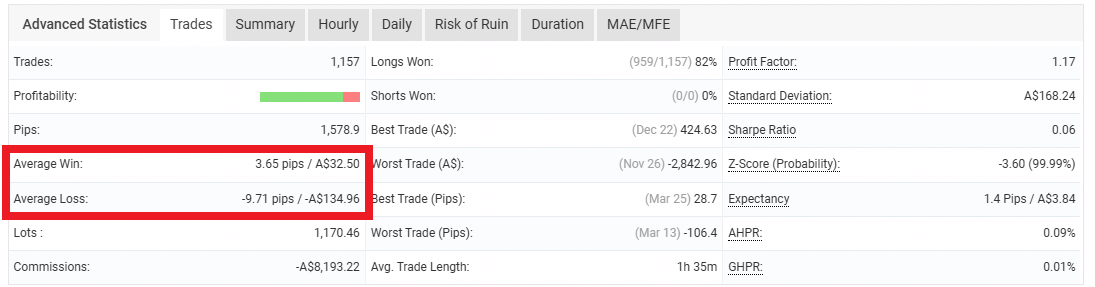
In the case study (live account), we saw a typical “small win, big loss” pattern:
average win ≈ 3.6 pips while average loss ≈ 9.7 pips.
This isn’t just bad luck. It happens because the design of scalping—ultra-short-term trading with small targets—naturally pushes systems toward that shape.
Structural reasons: scalping naturally creates “small take-profits and larger stop-losses”
Scalping aims to capture small moves in a short time, so the process often looks like this:
① small take-profit → ② costs matter more → ③ stop-loss gets wider → ④ execution + latency make it worse
- 1) Take-profit (TP) ends up close (wins stay small)
Because there’s only so much price can move in seconds or minutes, TP naturally becomes a few pips.
In other words, scalping starts with a structure where wins are small. - 2) When wins are small, costs become “heavy”
With tiny profits, spread + commission + slippage takes a bigger share.
Example: if TP is 3 pips but total cost is 2 pips, you keep around 1 pip in practice. - 3) Stop-loss (SL) tends to get wider (losses grow)
Ultra-short-term prices have more noise. If you place a tight SL, you can get stopped out by random fluctuations.
So many scalping systems leave more “room,” which often makes the loss several times larger than the win. - 4) Live execution tends to be biased against scalpers (TP is harder to hit, SL is easier to hit)
In live trading, TP can miss by “just a little,” while SL can be hit quickly during news spikes or spread widening.
That difference in how fills happen pushes the system toward larger losses. - 5) Latency hits hard (small targets make delays expensive)
Even a delay of tens of milliseconds can worsen entry/exit prices in scalping, making it easier to miss the win.
Meanwhile, stop-loss orders tend to trigger as expected—so losses remain.
“High win rate but the balance doesn’t grow” — a simple numbers example
Even with 8 wins and 2 losses out of 10 trades, small wins plus heavy costs can turn negative:
- Total wins: 3.6 pips × 8 = 28.8 pips
- Total losses: 9.7 pips × 2 = 19.4 pips
- Net: +9.4 pips (before costs)
- If total cost is 2 pips per trade: 10 trades = 20 pips of cost → −10.6 pips in reality
So even if the win rate looks strong, when small wins + big losses + heavy costs come together, expectancy can easily turn negative.
That’s a core reason scalping EAs often stall or collapse on live accounts.
Related:Stop Chasing Win Rate: How to Evaluate Forex EAs with Expectancy, Risk-Reward & Drawdown
Summary:
Scalping EAs tend to have close take-profits, wider stop-losses, and heavy exposure to costs and execution (slippage, spread spikes, latency). Together, these forces pull the system toward small wins and big losses.
That’s why this article recommends designs like M30–H1 timeframes, larger profit targets, positive risk-reward, and stop-order-based entries to improve reproducibility.
Scalping EAs: Evaluate Expectancy Including Trading Costs
Scalping EAs operate on very small profit targets, so spread, commissions, and slippage hit performance hard. Even with a high win rate, if the expectancy per trade is negative, the account won’t grow over time.
Related:FX Trading Expectancy (EV) Explained: EAs, Win Rate, Risk-Reward & Money Management
- Expectancy (pips) ≈ (Average Win × Win Rate) − (Average Loss × Loss Rate) − (Total Costs)
Example: TP 3 pips, SL 6 pips, Win Rate 60%
- Without costs: 3×0.6 − 6×0.4 = −0.6 pips per trade
- With total costs of 2 pips: −0.6 − 2 = −2.6 pips per trade
Takeaway: In scalping, it’s not the win rate that matters most—it’s the combination of win size, loss size, and total costs.
Practical Checklist for Scalping EAs (Quick)
- Estimate total costs first (spread + commissions + average slippage, converted to pips)
- Aim for an average profit target that is 5–10× your total costs; otherwise a small deterioration can break the edge
- Plug the numbers into the formula and confirm expectancy stays positive
Summary:
Scalping EAs can lose their edge with just a 1-pip shift in costs or execution. Calculating cost-included expectancy upfront helps you avoid being fooled by a “high win rate” that doesn’t actually translate into growth.
Checklist: How to Avoid Scalping EAs You Shouldn’t Buy (What You Can Verify Before Purchase)
Scalping EAs are heavily affected by broker execution, costs, and latency.
So if you buy based only on “the results look good,” you’re more likely to get burned on a live account.
Below are checks you can do before buying, often just by looking at the published data.
1) Data transparency (is the forward test hard to “game”?)
- A live-account forward test is published (not “Demo”).
- The forward page clearly shows broker name / account type / currency / leverage / fees.
- Tracking is public on a third-party site (e.g., Myfxbook / FX Blue), and open trade history isn’t hidden.
- The live track record runs at least 3–6 months continuously (not cherry-picked highlights).
- Backtest conditions are described in a realistic way, including variable spreads and slippage.
If you can’t see the history or the key conditions aren’t stated, it’s usually best to skip.
Related:How to Read Myfxbook: Spot Risky EAs (Balance vs Equity, Margin Spikes, Trade History)
2) Broker and execution terms (is it a “special-environment-only” EA?)
- The forward test uses a well-known, reputable broker (unknown brokers with little information are a red flag).
- The vendor doesn’t push only one specific broker as “required” (could mean the EA only works in that environment).
- The description acknowledges limits like freeze level and minimum stop levels, and the setup assumes SL/TP can be placed as designed.
- Operating conditions are explained clearly (e.g., spread limits, execution speed, slippage tolerance).
3) Latency assumptions (does the vendor state the required setup?)
- The vendor discloses VPS/location details (at least the region).
- A latency target is mentioned (e.g., “aim for under 10 ms”).
- You can tell which broker server location you need to be close to (country/city level is enough).
Note: With scalping, a difference of tens to hundreds of milliseconds can change results.
Related:VPS Location for MT4/MT5 EAs: Latency Targets, Equinix NY4/LD4/TY3, and How to Choose
4) Trading costs and frequency (does it look like a cost trap?)
- Total cost (spread + commission + average slippage) isn’t too heavy compared with the EA’s typical profit per trade (as a rough guide, keep it under half of the average target; lower is better).
- Higher trade frequency means costs dominate more—make sure you can picture “monthly trades × cost per trade.”
In scalping, “win rate” matters less than the cost ratio.
Related:MT5 EA Trading Costs Explained: Spread, Commission, Slippage & Swap (Backtest vs Live Reality)
5) Final decision: realistic rules to set before buying
- Testing on your own live account before purchase isn’t realistic. That’s why your decision should rely on transparent public data and clearly stated conditions.
- After purchase, don’t start with big money. Confirm behavior using minimum lot size + a short trial period (especially during spread spikes and slippage).
- If you can’t realistically match the vendor’s environment (broker/account type/VPS/location/trading hours), skipping the purchase is the rational choice.
If the data is transparent and you can realistically match the setup, you may have room to consider it.
Still, from a reproducibility standpoint, I generally don’t recommend scalping EAs—even under good conditions, the strategy remains highly environment-dependent.
How to Choose More Reproducible EAs (A More “Survivable” Alternative to Scalping)
When you’re fighting over a few pips, small differences in costs and execution can break performance.
More “survivable” EAs tend to share three foundations:
- Cost resilience: expectancy doesn’t collapse if spreads/fees rise slightly
- Execution resilience: slippage and latency are less likely to ruin outcomes
- Robust validation: not dependent on over-optimization; results hold under realistic conditions
The more a strategy meets the criteria below, the more likely it is to remain consistent across brokers and setups.
1) Timeframe and target: use M30–H1 and aim for moves that “don’t lose to costs”
- Timeframe: M30–H1 as a baseline (less noise than very short charts, and larger average moves per trade).
- Target size: aim for an average target that’s 5–10× the total cost (spread + commission + average slippage).
- Example: if total cost is 2.0 pips, a reasonable TP target is roughly 10–20 pips.
Beginner note: If the target is close to the total cost, expectancy can collapse with even a small change in conditions.
2) Order type: favor stop orders to reduce the downside of latency
- Stop orders (Buy Stop / Sell Stop) can trigger on the broker side when conditions are met, which can make results less sensitive to latency.
- Consider entries that rely mainly on Buy Stop / Sell Stop, not rapid-fire market orders.
- Place SL/TP as server-side orders (avoid “hidden stops” that depend on your terminal staying perfectly synced).
Note: This isn’t magic, but it’s generally easier to reproduce than ultra-short-term market-order scalping.
3) Risk design: positive risk-reward (RR ~ 1.5–2.5) and avoid dangerous tactics
- Use a clear stop-loss, and set take-profit to about 1.5–2.5× the stop-loss as a baseline.
- This structure can produce positive expectancy even with a 40–55% win rate (less dependence on “win-rate tricks”).
- Avoid averaging down, martingale, and grid approaches, which can blow up drawdowns quickly.
4) Robust validation: avoid over-optimization and test under realistic conditions
- There is a public live forward test (major broker, clear conditions, trackable history).
- Backtests use realistic assumptions such as variable spreads and slippage.
- Ideally, there’s walk-forward testing or reproducibility checks across multiple periods and conditions.
Related:
EA Overfitting (Over-Optimization): How to Detect It Before You Buy
EA Robustness Explained: How to Choose a Forex Trading Robot That Won’t Blow Up
Summary:
More reproducible EAs tend to use larger targets, tolerate execution/cost noise, and rely on realistic validation.
If you want an alternative to scalping EAs, start by checking whether the strategy meets:
M30–H1 timeframes × targets 5–10× costs × positive risk-reward × realistic testing.
Conclusion: I Generally Don’t Recommend Scalping EAs (Low Reproducibility)
Scalping EAs depend heavily on execution conditions and trading costs, which makes it hard to reproduce the same results over the long run.
Don’t blindly trust a smooth demo equity curve or strong results on one specific broker.
- Minimum requirement before you even consider buying:
There should be public live forward results on a major broker (clear account type, broker, fees, and trackable history), and you should be able to realistically match the key setup conditions (broker/account type/fees/VPS location/latency/trading hours). - If you care most about reproducibility, use this alternative guide:
Choose EAs that trade on M30–H1, target moves that are 5–10× total cost (spread + commission + average slippage), use positive risk-reward (RR ~ 1.5–2.5), rely more on stop-order-based execution, and avoid over-optimized testing (realistic backtests + ongoing live forward verification).
Don’t chase the “high win-rate illusion.” Strategies that are cost-resilient and validated under realistic conditions are the practical way to protect capital and grow over time.
 MQL5
MQL5
 Myfxbook
 YouTube
 X
X
 GOGOJUN