

Can a Martingale EA actually make money?
(I’m curious about EAs that double lot size, average down, or use grids…)

In most cases, I don’t recommend it.
A Martingale EA can look “safe” in the short run—like it rarely loses and keeps rising smoothly—but its core nature is that it’s prone to eventually blowing up an account.
A “beautiful profit curve” is often just big losses being pushed into the future. Be careful.
But if the forward test is going up steadily, isn’t it safe?
No. A Martingale EA often has a structure where it keeps winning until a “blow-up event” hits.
Great short-term forward results may simply mean it hasn’t stepped on the landmine yet.
In this article, I’ll show what happens when you extend the backtest period and how to spot a Martingale EA by reading trade history, with clear examples.
As a beginner, what should I look at to realize “this is a Martingale EA”?
The most important thing is trade history.
• Lot size jumps right after a loss (often doubling)
• Positions are added step-by-step in the same direction (grid / averaging down)
If you see these patterns clearly, assume it’s a high blow-up risk strategy.

Don’t Get Tricked by Martingale EAs
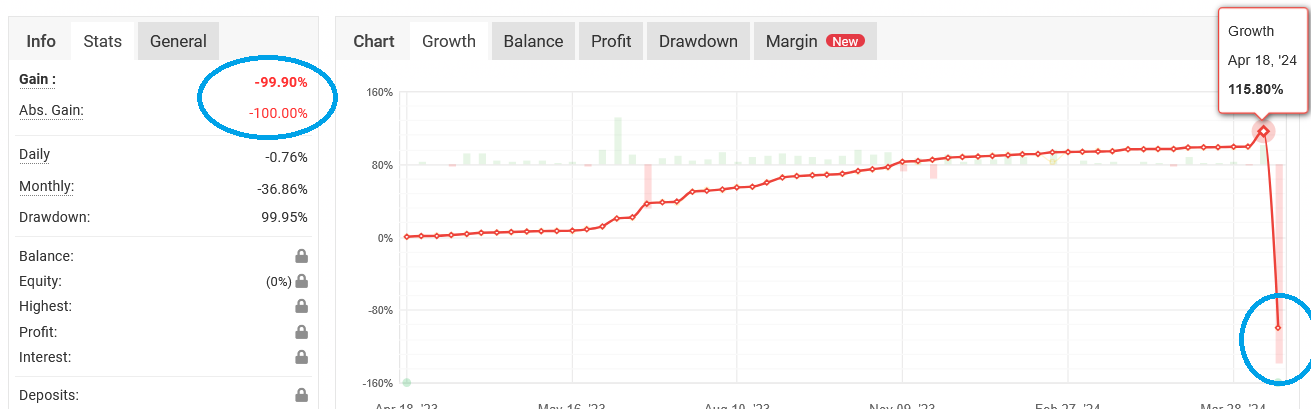
“99% win rate.” “A perfectly smooth equity curve.” Have you ever seen a performance chart like that and felt tempted?
In reality, many of those “too-perfect” curves are an illusion created by Martingale EAs.
Let me be direct: stay away from Martingale EAs. The longer you run them, the higher the chance you won’t be able to protect your account in the end.
A Martingale strategy is basically this idea: “If you lose, double the bet. When you finally win once, you recover everything.”
On paper it looks simple—and that’s exactly why it’s dangerous.
Markets can drain your balance relentlessly while you’re waiting for that “eventual win,” and it’s common for margin to run out before that ‘one win’ arrives.
Also, a rising profit curve is not proof of safety. In many cases, it simply means the strategy is pushing the probability of one massive loss (a blow-up event) into the future.
The day you hit that hidden landmine will come sooner or later.
What Is the Martingale Strategy?
The Martingale strategy originally comes from gambling-style money management. The idea is very simple:
- Lose → double the next bet
- Win once → recover all previous losses and keep a small profit
In theory, if you had unlimited capital and unlimited attempts, you wouldn’t go broke.
But real trading isn’t like that. Capital is limited, and losing streaks longer than you expect happen all the time.
As a result, while the lot size (the “bet”) keeps doubling, margin requirements grow faster than your account can handle.
That’s the core weakness of Martingale: you run out of money before you get that one win.
That’s why, in live trading, it tends to be a strategy that drifts toward eventual failure.
Two Common Martingale EA Types in Trading
In FX and EAs, Martingale strategies usually fall into two main types. Both can look great in the short term, but structurally they carry account blow-up risk.
Type 1: Stop Loss (SL) + Double the Lot After a Loss
This type takes a loss with a stop loss (SL), then tries to recover by doubling the lot size on the next trade.
If it wins quickly, it can recover the previous loss fast, so the balance curve can look smooth and “healthy”.
The problem appears when losses continue. Even one or two extra losses beyond your expectation can make the lot size explode, and margin needs jump sharply.
That’s when the account can run out of room and hit a practical limit.
On top of that, in volatile conditions you often get spread widening and slippage, so trades may not close at the intended SL/TP. That can drain the account faster than the design assumes.
Type 2: Grid + No Stop Loss (Hold and “Wait for a Comeback”)
This type adds positions in the same direction as price moves against you, pulling the average entry closer—this is the classic grid / averaging down approach.
If price comes back, the floating loss can disappear quickly, and the EA may close everything for a profit.
In range-bound markets, it can look like it “wins every day.”
But once a strong trend locks in, the situation flips. The further price runs, the more positions are added, and floating loss grows like a snowball.
If price doesn’t come back, you get a single margin call wipeout, or you end up unable to cut the loss and hold for a long time with your funds trapped.
Even when the curve looks clean, the risk of a huge loss is still there.
Related:Why Grid Forex EAs Blow Up: Hidden Drawdowns + Red Flags (Self-Made EA Test)
[Test] Type 1 Martingale EA (SL + Lot Doubling After a Loss) Fails Over the Long Run
In this section, I use a sample EA I built (a testing EA designed to reproduce typical Martingale behavior) and check what happens in backtests.
Conclusion: Even if it rises in a short window, extending the test period makes blow-up risk show up clearly.
That’s because Martingale tends to fail due to rare but severe losing streaks.
Test Settings: My Sample EA (SL + Lot Doubling After a Loss)
| Logic | MA (Moving Average) 20/50 cross, SL=100 pips / TP=100 pips, double the lot on the next trade after a loss |
|---|---|
| Symbol / Timeframe | EURUSD / H1 |
| Initial balance / Initial lot | 1,000 USD / 0.01 |
| Leverage | 1:500 |
| Test periods | (1) 2020–2025 (2) 2012–2025 |
Test 1: 2020–2025 Goes Up (But It’s Fragile)
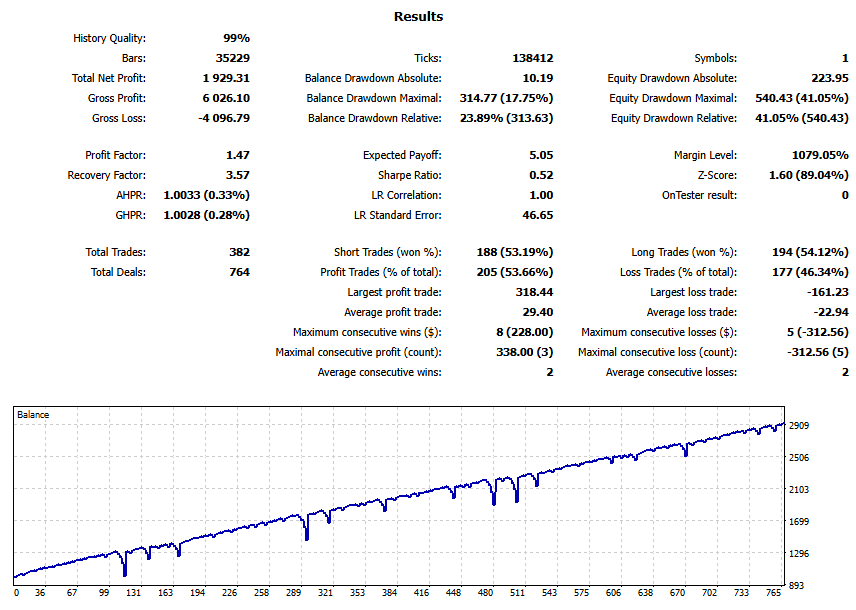
The stats look strong at first glance. But you can see moments where the drawdown drops sharply—those deep “valleys” matter.
Test 2: 2012–2025 Ends in Collapse (Practical Blow-Up)
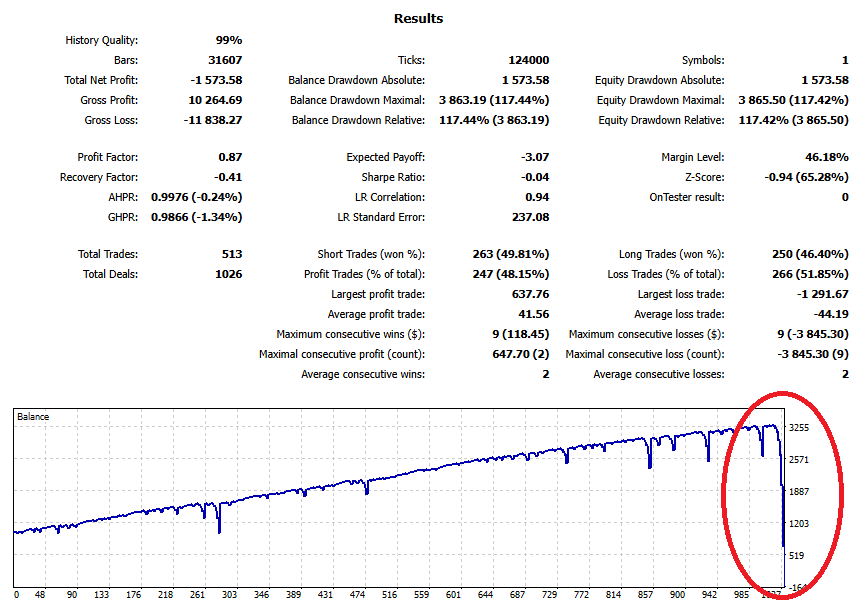
The longer the test period, the higher the chance you run into the losing streak you don’t want to see.
Because lots double after each loss, margin requirements grow exponentially.
Once you hit something like a 9-loss streak, the account typically can’t survive the combo of margin pressure → stop-out.
Why It “Works Short-Term” but Breaks Long-Term
- Market regime dependence: 2020–2025 simply didn’t produce a long enough losing streak. Extending to 2012–2025 increases the odds—and once the streak hits, the system breaks.
- Tail risk delayed: A rising curve often means you just haven’t hit an extreme event yet. When it arrives, it can erase past gains in one shot.
- Margin explodes: Doubling lots pushes required margin up so fast that you can run out of funds before you get the “one win” you need.
A Simple Formula View: With Lot Doubling, Money Loses in the End
Even with equal SL/TP = 100 pips, the total loss after n consecutive losses scales as:
loss_total = pips × lot_0 × (2^{n} - 1) (ignoring fees, swaps, etc.)
For example, with lot_0=0.01 and 9 losses in a row, 2^9-1 = 511.
That scale is simply not realistic for a finite account to absorb.
Key Takeaway: Type 1 (SL + Lot Doubling) Tends to End in Failure Over Time
A Martingale EA that doubles the lot after losses can look profitable short-term, but it tends to drift toward failure long-term.
A smooth equity curve can be a time-window trap.
Evaluate with long test periods and losing-streak tolerance, and move toward a safer design: fixed risk per trade, realistic stop losses, and positive expectancy.
[Test] Type 2 Martingale EA (Grid + No SL) Can Wipe an Account to Zero in One Move
Conclusion: It can produce a smooth curve during range periods, but once it gets caught in a strong trend, it can implode in one hit.
A grid “hold and wait” approach trades a high win rate for a much larger tail risk.
Test Settings: Grid + No Stop Loss (Hold and Wait)
| Logic | Grid (fixed spacing) + no stop loss / add positions in the same direction as price moves against you (lots may increase or stay fixed), then close all on a retracement to realize profit |
|---|---|
| Timeframe | H1 |
| Initial balance / Initial lot | 1,000 USD / 0.01 |
| Leverage | 1:500 |
| Period | 2010–2025 |
| Pairs | EURUSD (main) / USDCAD (reference, same settings) |
Test 1: USDCAD Rises Smoothly (The “I Win Every Day” Range Illusion)
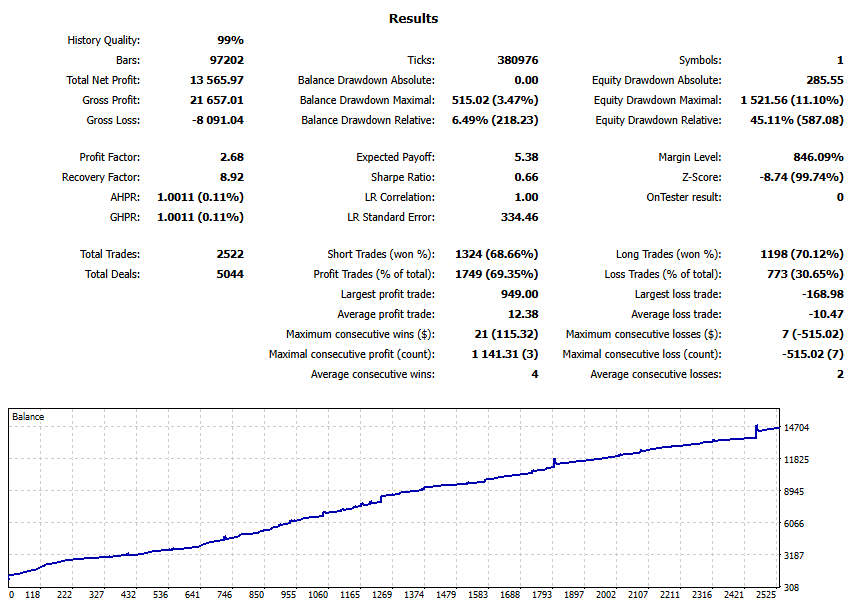
In a range where price keeps swinging back and forth, grid systems often do well—and that can show up in short forward tests too.
This creates a sense of safety and overconfidence.
Test 2: EURUSD Gets Caught in a Trend and Drops to Zero (Account Blow-Up)
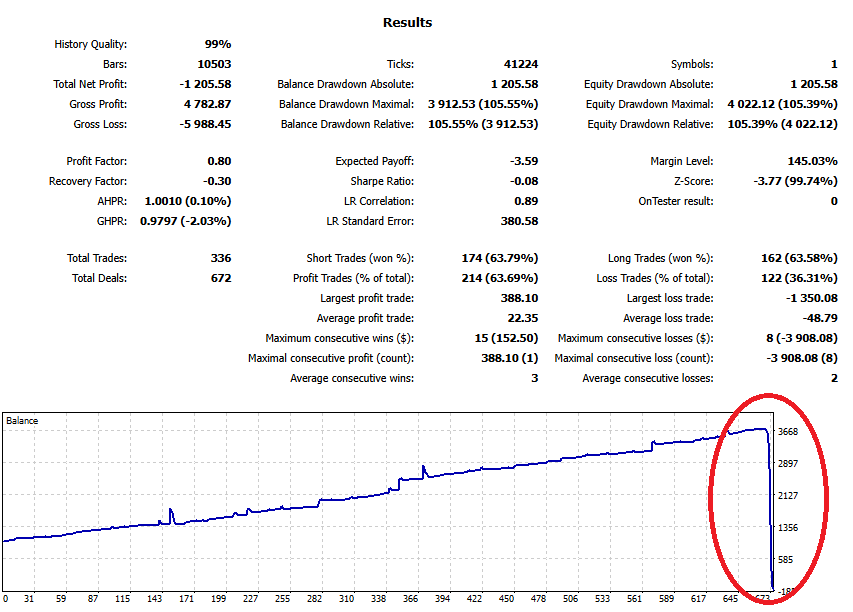
As price keeps moving against the position, the EA adds trades step-by-step, and both required margin and floating loss grow at the same time.
When spread widens and slippage hits, a stop-out can erase the account quickly.
A rising curve in the short term often means only one thing: the blow-up event hasn’t happened yet.
Below is the chart screen around the moment the account blew up. It made steady profits in range periods, but when a strong downtrend appeared, the added positions (with increasing lot size) chained together until margin ran out and the account hit a stop-out.
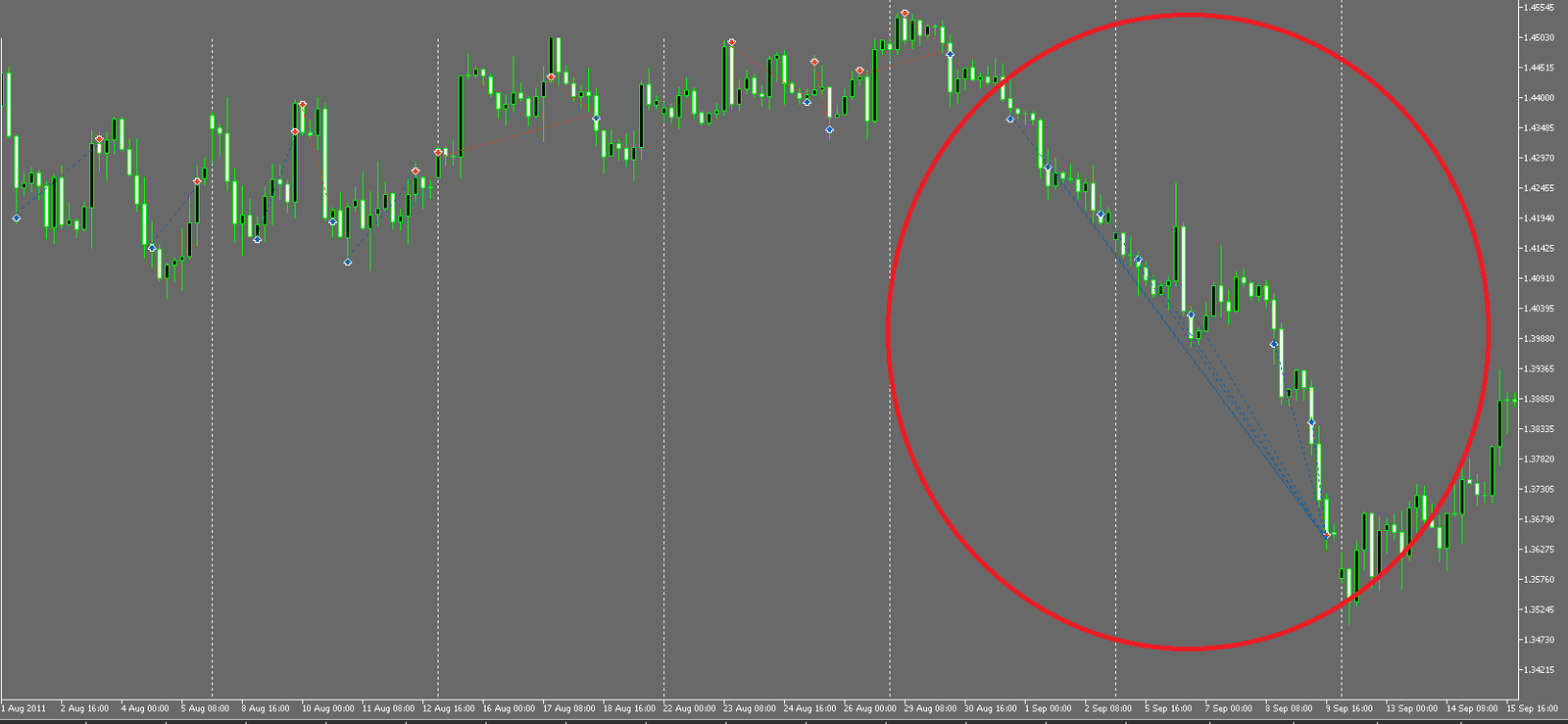
Why Results Change So Much Just by Switching the Pair or the Period
- Market regime dependence: USDCAD may spend more time in range-like conditions, while EURUSD can produce stronger one-way moves. A “wait for a comeback” grid can fail badly in those conditions.
- The grid limit: Averaging your entry price moves little by little. Strong trends can outrun the average before any real pullback arrives—so margin runs out first.
- Tail risk grows: Win rate can be high, but a rare huge loss can erase all profits (and more).
- Real-world costs: Swap accumulation from long holding, plus spread widening and slippage, can make outcomes worse and speed up failure.
Formula Intuition: A Grid Can “Snowball” Out of Control
Let the grid step be Δp, the number of added positions be k, and lots be l_0, l_1, …, l_k. Then required margin is roughly proportional to M ≈ Σ l_i.
If lots increase with a multiplier m>1, then Σ l_i = l_0·(m^{k+1}-1)/(m-1)—a geometric series.
Your average entry moves only so far, but required margin grows exponentially. That’s the fatal flaw of “hold and wait” grids.
Key Takeaway: Grid + No SL Is “Stability That Isn’t Real”
A grid Martingale EA with no stop loss is “fake stability” optimized for range conditions.
Just changing the pair or the period can push the account to zero.
Test with long periods, multiple pairs, and worst-case assumptions, and move to a design that assumes stop losses and aims for positive expectancy.
Low Leverage Accounts Make Martingale Grids Break Faster
Even with the same strategy, a Martingale grid becomes much harder on a low leverage account.
The reason is simple: lower leverage means more margin required per lot.
So even if the EA wants to add grid positions, it may run out of margin first—and you get pushed toward a stop-out sooner than expected.
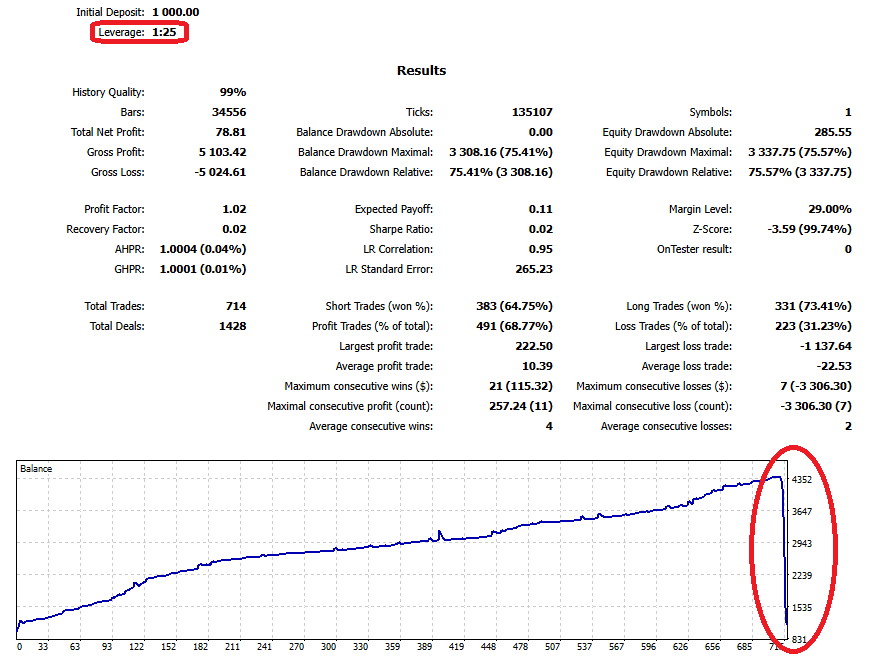
Example Test: USDCAD (Grid + No SL) Blows Up at 1:25 Leverage
I re-tested the Type 2 case (grid + no stop loss) on USDCAD with the same settings, but reduced leverage from 1:500 to 1:25.
The result was an account blow-up.
Here is the report from that test:
Why Low Leverage Breaks It More Easily
- Margin requirement rises: Lower leverage means you need more margin for the same lot size, so you lose the room needed to add positions quickly.
- If you can’t add, the “comeback” plan fails: A grid assumes you can add positions to pull your average entry closer. Low leverage often stops that mid-way, leaving you stuck with a large floating loss.
- Floating loss reduces free margin: As floating loss grows, free margin shrinks, which makes it even harder to add. Then margin level drops fast and a stop-out becomes likely.
- A high win rate becomes meaningless: Even if it wins often, a low leverage account has less “survival power,” so one strong move can end everything.
Simple Picture: Max Position Size Shrinks with Leverage
Skipping the heavy math, here’s the key point: as leverage drops, the maximum total lot size you can hold also drops.
For example, if leverage becomes one quarter, then the maximum lot capacity is also roughly one quarter.
That’s why grid strategies tend to get stuck mid-build on low leverage accounts.
Key Point: Why Vendor Results Don’t Reproduce on Your Account
- Performance curves from a vendor’s high leverage / large balance account often won’t reproduce on a low leverage / small balance account.
- Martingale grids depend heavily on leverage and account size. Same settings, different account conditions, very different outcomes.
- If you test, change leverage (e.g., 1:25 / 1:50 / 1:100) and check how fast free margin shrinks and how close you get to a stop-out.
Conclusion: The lower the leverage, the easier a Martingale grid breaks—and the faster it reaches failure.
Related:High Leverage for Forex EAs: The Real Risk Is Lot Size (Margin + Safety Rules)
Small Accounts Hit the Limit Fast with Martingale EAs
A Martingale strategy is basically “survive with account balance.”
If your balance is small, you run out of margin before you can build the next positions, so you can’t recreate the vendor’s smooth uptrend curve.
Before win rate even matters, you hit the hard limit of account size.
- Lot size grows quickly: 0.01 → 0.02 → 0.04 → 0.08… It doubles fast. A few losses can make margin needs jump dramatically.
- Margin runs out first: As losses or adverse moves continue, total exposure grows and free margin drops quickly. Smaller accounts reach stop-out conditions in fewer steps.
- Vendor results are hard to replicate: A large account might survive the same situation, while a small account blows up at the exact same moment.
Adding Compounding (Auto Lot Increase) Can Make the Blow-Up Happen Sooner
Compounding—automatically increasing lot size as the balance grows—can be a strength of EAs. Used correctly, it can grow a small account over time.
But compounding and Martingale don’t mix well.
The more you increase your lot size, the bigger the damage when the next adverse move hits—and failure arrives sooner.
- Compounding assumes losses stay controlled: Safe compounding starts with a plan to keep each loss small. Martingale does the opposite—lots increase after losses—so losing periods get heavier.
- It collapses fast in bad periods: Compounding accelerates growth, but Martingale also accelerates losses when price keeps moving against you. When both amplify at once, the account’s survival time shrinks.
Related:EA Lot Size & Position Sizing: Fixed vs Auto Lot, Risk % Rules, and Starting Deposit Math
Watch Out for Dishonest Martingale EA Sales Tactics (Common Patterns)
Martingale EAs can easily look profitable by design.
That makes it easier for sellers to comfort beginners with backtests that “never lose” or short-term forward results, then push the EA as “safe.”
Here are the key points dishonest sellers don’t want you to notice—and why beginners get misled.
1. It’s Easy to Create a “Never-Loses” Backtest Curve
- By tuning settings to match a specific period, symbol, and parameter set, it’s possible to produce a chart that looks like it rarely loses.
- If results are presented with the assumption “we hold until it comes back,” the curve can look even smoother—even with large floating losses.
- But that may simply be a lucky setup that avoided the dangerous periods, not a safe strategy.
Related:How to Read MT5 Backtests: Verify EA Risk with Equity DD & Orders/Deals
2. Short-Term Forward Tests Often Go Up
- Martingale systems tend to accumulate profit until the big losing day arrives.
- So in many cases, it’s not surprising that short-term forward tests look like a steady uptrend.
- But “it’s running live” doesn’t mean it’s safe. It may simply mean it hasn’t hit the landmine yet.
Related:How to Read Myfxbook: Spot Risky EAs (Balance vs Equity, Margin Spikes, Trade History)
3. Run Many Forward Accounts and Show Only the Winners (Survivorship Bias)
- Some sellers run many similar EAs at the same time and use only the accounts that happened to survive as marketing material.
- Even if “1 out of 100 accounts” looks great, that may not mean the strategy is good—it may mean that one account got lucky.
- If losing accounts are hidden, readers won’t see the real failure rate.
4. The Vendor Account Already Has a Lower Risk of Ruin (You Can’t Replicate It)
- Martingale depends heavily on account size (balance). The larger the balance, the higher the survival odds. Smaller accounts can blow up sooner with the same settings.
- A vendor’s “survivor” account may already be large after a good run. A larger balance reduces the chance of ruin and looks even more attractive.
- But that situation is not something you can easily recreate from a small account starting today.
How to Spot a Martingale EA: A Trade History Checklist
You can’t judge this by a “rising curve” alone.
What you should check is trade history. This is the most important.
- Lot size growth: Does the lot size jump right after a loss (e.g., 0.01 → 0.02 → 0.04…)?
- How positions are added: When price moves against it, does it add positions step-by-step in the same direction (grid / averaging down)?
- Floating loss size and duration: Are there long periods where a large floating loss is held (a “wait for a comeback” style)?
- Profit/loss imbalance: Is the win rate unusually high, but wins are tiny and losses are huge (small wins, big losses)?
- Lot size vs. account size: Are lots heavy relative to balance, causing margin needs to spike quickly during adverse moves?
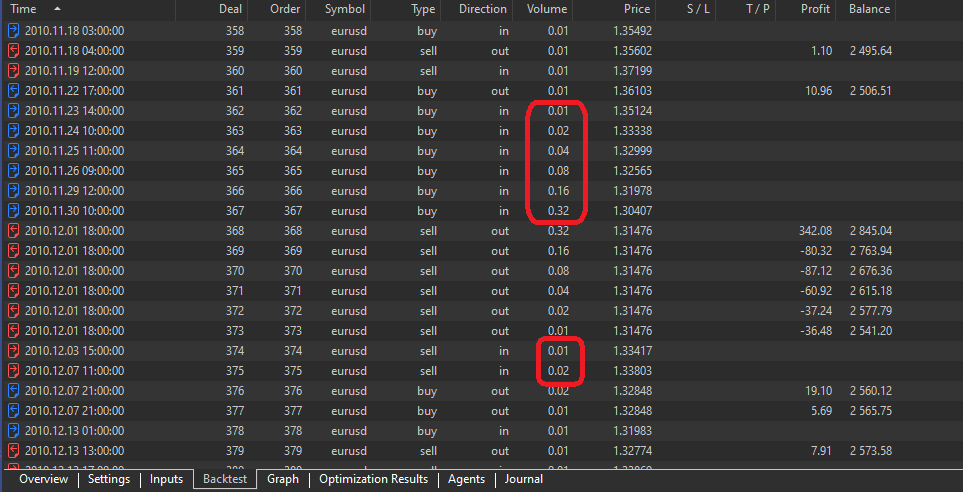
Quit Martingale and Survive: Safer Risk Management (Alternatives)
If you want to avoid Martingale EAs, the next step is to switch to a design that grows the account while protecting it.
The key is to reduce risk with rules, not luck. Use these as a baseline:
- Fix the maximum loss per trade (e.g., up to 0.5%–1% of the account)
- Always use a stop loss (SL) (don’t rely on “it will come back”)
- Aim for wins bigger than losses (small losses, larger wins)
- Build a strategy that tends to stay positive overall (don’t judge by win rate alone)
- Set a maximum drawdown limit (reduce size or stop when it’s hit)
- Test assuming losing streaks will happen (confirm “how many losses can you survive?”)
One-Line Summary: Decide “How You Lose” Before You Decide “How You Win”
Safer trading starts by deciding not “how to win,” but how to lose (where to stop).
That mindset alone can greatly reduce the “one-hit wipeout” risk that Martingale brings.
Conclusion: I Don’t Recommend Martingale EAs (Avoid Them If You Want to Protect Your Account)
Martingale EAs look very tempting.
“A smooth uptrend curve,” “small daily profits,” “high win rate”—it’s easy to feel safe when you see those.
But that feeling is exactly the danger. Martingale often wins until the big losing day arrives, and then you can lose everything in one hit.
So ask yourself this:
Can your account survive just one extreme move (an abnormal market day)?
If you’re not fully confident, the answer is simple.
Final Answer: The Safest Choice Is Not to Choose a Martingale EA
Don’t choose a Martingale EA.
That’s the most reliable way to protect your account and stay in the game long-term.
FAQ: Common Questions About Martingale EAs
- Q. What’s the fastest way to notice an EA is using Martingale?
- A. Check trade history. If lot size increases right after a loss and it adds positions in the same direction with larger lots, there’s a very high chance it’s Martingale.
- Q. If I have enough capital, is a Martingale EA safe?
- A. I don’t recommend it. “Enough” is vague. Big losing streaks and strong trends happen eventually. Because Martingale increases lot size after losses, even a large account can still hit a limit one day.
- Q. If a short-term forward test is rising, can I trust it?
- A. No. Martingale systems often look good until the bad day arrives. A short-term uptrend may simply mean that bad day hasn’t come yet.
- Q. Can a “safer” grid + Martingale design work?
- A. It’s difficult. It can profit in range markets, but a strong trend can break it fast. The core risk doesn’t disappear, so if you trade at all, move to a design with a real stop loss (SL).
- Q. What happens on a low leverage account?
- A. Margin required per lot increases, so you can’t add positions as easily. Grid builds and lot doubling can get stuck mid-way, floating loss grows, and you move closer to a stop-out.
- Q. Why do sellers show “only winning EAs” from many forward tests?
- A. If you run many accounts, some will avoid dangerous markets by chance. Showing only the winners hides the losers and makes the strategy look safer than it really is.
- Q. Why can’t I replicate the vendor’s results on my account?
- A. Martingale depends heavily on balance and leverage. Vendors often have larger balances or better conditions, so the same settings can behave very differently on your account.
 MQL5
MQL5
 Myfxbook
 YouTube
 X
X
 GOGOJUN